Overview
Navaratri — the 'nine nights' of the Divine Mother — is among the most beloved festivals across South India. In Tamil Nadu, it is celebrated as Golu: an elaborate display of dolls arranged on tiered steps (kolu padi) in homes and temples, depicting deities, sages, royal court scenes, and tableaux from the Puranas. The first three nights honour Durga, the next three Lakshmi, and the final three Saraswati — culminating in Vijayadashami, the tenth day of victory.
Significance
Navaratri celebrates the Divine Feminine in her three principal aspects: Durga (the power that destroys evil), Lakshmi (the wealth that sustains life), and Saraswati (the knowledge that liberates). Vijayadashami, the tenth day, commemorates Durga's victory over the buffalo-demon Mahishasura — and is considered the most auspicious day of the year for beginning new ventures: starting school, learning music, beginning trade. At Meenakshi Amman Temple, the goddess is dressed in nine successively grander alankarams across the nine nights.
The Story Behind the Festival
The asuras Mahishasura and Sumbha-Nisumbha had performed great penance and obtained boons making them invincible to any male being. They terrorised the heavens. The devas, helpless, pooled their divine energies into a single radiant form — Devi Durga — who rode out on a lion and battled the demons for nine nights, finally slaying Mahishasura on the morning of the tenth day. The nine nights are remembered as Navaratri, the tenth as Vijayadashami — 'the day of victory'.
Rituals & Observances
- Households set up a Golu — an odd-numbered stepped display (3, 5, 7, 9 steps) of clay and wooden dolls depicting deities, sages, weddings, royal court scenes, and Puranic tableaux.
- A kalasham (decorated pot representing the goddess) is placed at the centre of the display and worshipped each evening.
- Women visit each other's homes to view their Golus; visitors are offered sundal (lentil snacks), tamboolam (betel leaf, areca nut, coconut, fruit), and a small return-gift.
- Saraswati Pooja on the ninth day: books, musical instruments, and tools of one's trade are placed before the goddess and worshipped — no work is done that day.
- Vijayadashami: the books are reopened with reverence (Vidyarambham) — a traditional day for beginning new learning. Children are inducted into formal study, sometimes by tracing their first letter in a tray of rice.
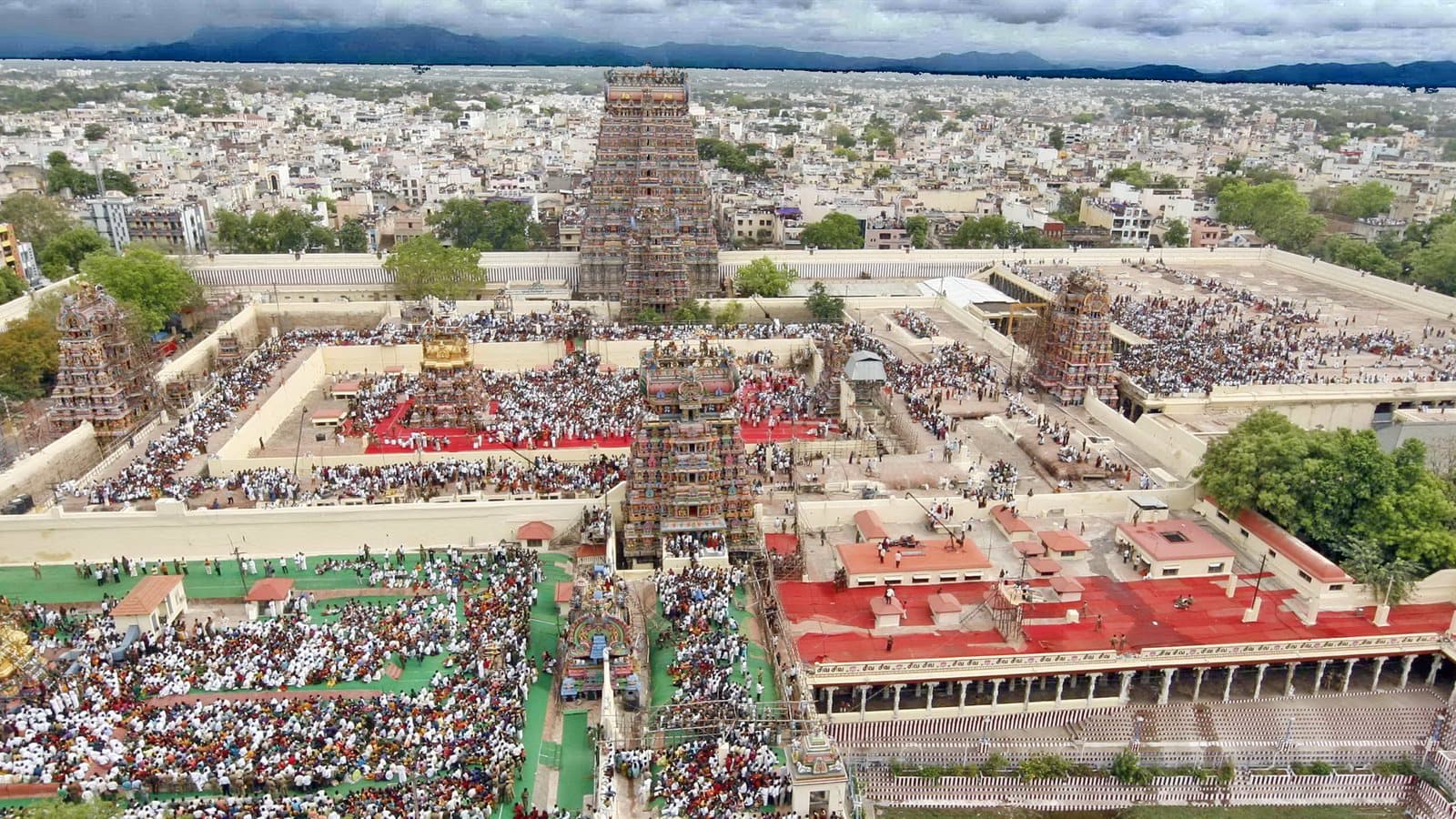
- At Meenakshi Amman Temple: special alankarams of the goddess in nine forms (Navadurga); a large temple-Golu is displayed in the corridors.
When & Where
For Devotees
Even if you can't visit a temple, set up a small Golu at home — even three steps with a few dolls and a kalasham is enough. Invite neighbours to view it and share sundal — the social warmth of Navaratri is as important as the worship. On Vijayadashami, place your books and tools before the goddess in the morning; pick them up only after a small puja. This is the most auspicious day of the year to begin learning music, language, or a new craft.