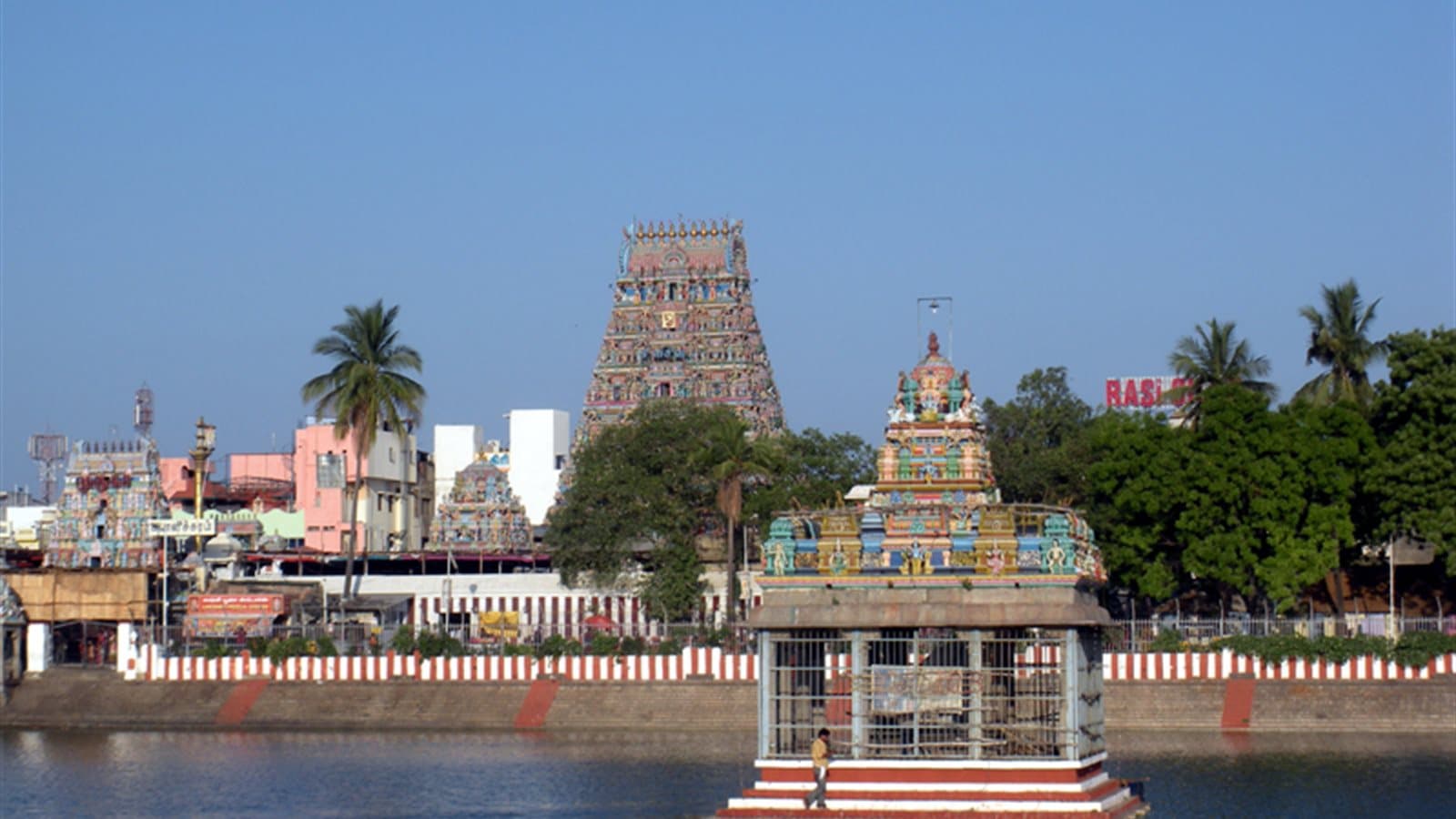
Kapaleeswarar Temple
Chennai's most iconic temple in the historic Mylapore district. The spectacular 37-meter gopuram and 63 Nayanmars (saints) depicted in the complex make it a cultural landmark.
Official WebsiteHistory
Kapaleeswarar Temple is dedicated to Lord Shiva as Kapaleeswarar and his consort Parvati as Karpagambal, in the ancient settlement of Mylapore (Tamil Mayilai, 'the place of the peahen'). Mylapore is far older than the city of Chennai that grew around it: it was a flourishing port mentioned by the 2nd-century geographer Ptolemy, and the home of the Nayanmar saint Tirugnana Sambandar's miracles. The original Kapaleeswarar shrine is traditionally said to have stood on the seashore near present-day Santhome and to have been demolished by the Portuguese in the 16th century, when the San Thome Cathedral was raised on the coast. The temple was rebuilt about a kilometre inland at its present site around the 16th–17th century under Vijayanagara-era patronage; the soaring east gopuram in its current form dates to a renovation completed in 1906. The temple is administered by the Hindu Religious and Charitable Endowments (HR&CE) Department of Tamil Nadu. Despite the relocation of the structure, the sanctity of the site is vouched for by the Thevaram hymns, which place the deity firmly at Mylapore more than 1,300 years ago.
Mythology & Legend
The Legend
The name Mylapore comes from the Tamil 'Mayilai' or 'Mayilapur', the city of the peahen, and the story behind it is the central legend of this temple. On Mount Kailash, while Lord Shiva was expounding the meaning of a sacred mantra to Parvati, the goddess was momentarily distracted by the sight of a dancing peacock. Displeased that her attention had wandered, Shiva asked her to descend to earth and do penance. Parvati took the form of a peahen (mayil) and came to this spot on the Coromandel coast, where she fashioned a lingam of earth beneath a Punnai tree and worshipped it with deep devotion. Pleased by her penance, Shiva appeared, restored her to her original form and married her here. To this day the goddess is enshrined as Karpagambal, and a small shrine under the sacred Punnai tree shows her in the form of the peahen worshipping the lingam, the very image of the legend that gave Mylapore its name.
The Divine Wedding
The Thirukalyanam, the celestial wedding of Lord Kapaleeswarar and Goddess Karpagambal, is re-enacted as the climax of the ten-day Panguni Brahmotsavam, which falls in the Tamil month of Panguni around the Uthiram star. The festival recalls Shiva's marriage to Parvati at Mylapore after her penance as the peahen. The processional bronzes of the divine couple are richly adorned and brought together for the marriage rite, witnessed by enormous crowds, the same union celebrated on Panguni Uthiram at many of the great Shiva and Murugan temples of the Tamil country.
Poompavai Brought Back from Her Ashes
The most beloved miracle of Mylapore concerns a merchant of the town, Sivanesan, and his daughter Poompavai, an ardent devotee of Shiva who longed to see the child-saint Tirugnana Sambandar. Before he could arrive, Poompavai died of a snakebite. Rather than complete her cremation, her grieving father preserved her bones and ashes in a pot, hoping the saint might still see her. When Sambandar came to Mylapore he asked to be shown the girl; on learning what had happened, he sang the 'Mattita Punnai' hymn (the Poompavai Pathigam) before the pot. As the verses were sung, Poompavai emerged from the ashes, restored to life as a grown girl. The episode, sung in the Thevaram itself, is one of the most famous resurrection legends of the Tamil Shaivite tradition and is closely associated with this temple and its sacred Punnai tree.
Why Shiva is Called 'Kapali'
The deity's name Kapaleeswarar derives from 'kapala' (skull or cranium). In the Puranic tradition the name recalls the episode in which Lord Shiva severed one of the five heads of Brahma to humble his pride, carrying the skull (kapala) as he wandered. As Kapali, the bearer of the skull, Shiva embodies the destruction of ego and the transcendence of birth and death, the form in which he is worshipped at Mylapore.
Architecture
The temple is a classic example of South Indian Dravidian architecture on a compact urban plan, oriented to face east. Its dominant feature is the ~37 m east rajagopuram, a nine-tiered tower whose every surface is crowded with brightly repainted stucco figures of gods, sages and Puranic episodes; a smaller gopuram stands on the west, facing the temple tank. Within the high prakaram (enclosure) walls sit the main sanctum of Kapaleeswarar (a Shiva lingam), the separate west-facing shrine of Goddess Karpagambal, the brass-clad flagstaff (kodimaram) and bali peetam, and a Nandi mandapam. Pillared corridors line the inner courtyard, and a small shrine under the Punnai tree (the temple's sthala vriksham) holds the image of the goddess in the form of a peahen worshipping the lingam. The large stepped temple tank (Kapali Theertham) lies just outside the west gopuram and is the stage for the annual float festival.
East Rajagopuram
gopuramராஜகோபுரம்
The towering ~37 m (nearly 120 ft) nine-tiered eastern gateway tower, the landmark of Mylapore, rebuilt in 1906. Every tier is densely populated with brightly painted stucco figures of deities, dvarapalas and Puranic scenes, periodically repainted in vivid colours during kumbhabhishekam.
~37 m · 9 tiers · rebuilt 1906
West Gopuram
gopuramThe smaller western gateway tower, facing the temple tank. The float festival processions and the goddess's tank rituals pass through this gateway toward the Kapali Theertham.
Kapaleeswarar Sanctum
sanctumThe east-facing main sanctum (garbhagriha) enshrining Lord Shiva as a lingam, Kapaleeswarar. Fronted by the Nandi mandapam, the brass-clad flagstaff (kodimaram) and the bali peetam, in line with the east gopuram.
Karpagambal Shrine
sanctumகற்பகாம்பாள்
The separate, prominent shrine of Goddess Karpagambal ('goddess of the wish-yielding Karpaga tree'), much venerated in her own right. Devotees offer worship here for boons, marriage and family welfare.
Punnai Tree Shrine (Sthala Vriksham)
otherThe temple's sacred tree, an ancient Punnai (Calophyllum inophyllum). Beneath it stands a small shrine showing Parvati in the form of a peahen worshipping the lingam, the scene of the founding legend that named Mylapore.
Kapali Theertham (Temple Tank)
tankThe large stepped temple tank just west of the temple, surrounded by mandapams. It is the centrepiece of the annual three-night float festival, when the illuminated teppam carries the deities in circuits around the water.
Nayanmar Corridor
mandapamThe prakaram corridor where bronze and stone images of the 63 Nayanmar saints are installed. During the Arupathimoovar festival these figures are taken out together in the famous procession around the Mada streets.
Sub-shrines & Other Deities
Goddess Karpagambal
Parvati as the Wish-Granting GoddessThe principal goddess shrine, dedicated to Parvati as Karpagambal. She is worshipped for boons, prosperity and auspicious marriage; the Friday and Navaratri alankarams of the goddess draw large crowds.
Singaravelar (Murugan)
Lord Murugan with Valli and DeivanaiThe shrine of Murugan as Singaravelar, a focus of the Skanda Sashti celebrations and a central figure in the float festival, when he is taken out on the teppam with his consorts.
The 63 Nayanmars
The Tamil Shaivite SaintsImages of the sixty-three Nayanmar saints whose lives are recorded in the Periya Puranam. Honoured year-round and carried in the grand Arupathimoovar procession during Panguni.
Navagraha Shrine
The Nine Planetary DeitiesThe shrine of the nine planets, where devotees offer worship and light lamps to mitigate planetary afflictions, a customary stop within the temple circuit.
Vinayaka (Ganesha)
Lord GaneshaThe obstacle-remover, worshipped first on entering the temple. The Vinayaka Chaturthi festival is observed here in the month of Aavani.
Highlights
- 1The spiritual and cultural heart of Mylapore, one of the oldest residential quarters of Chennai
- 2Towering ~37 m (nearly 120 ft) east rajagopuram, rebuilt in 1906 and covered in vividly painted stucco figures
- 3A Paadal Petra Sthalam, sung in the 7th-century Thevaram hymns of Tirugnana Sambandar, Appar and Sundarar
- 4The Poompavai legend: Sambandar's 'Mattita Punnai' hymn that brought a girl back from her ashes
- 5Karpagambal, the wish-granting goddess, worshipped here as a peahen (mayil) under the sacred Punnai tree
- 6The 63 Nayanmar saints depicted as bronze and stone figures, carried in the famous Arupathimoovar procession
- 7A deep heritage of Carnatic music, Bharatanatyam and the surrounding Mylapore festival arts season
Festivals & Events
Panguni Brahmotsavam
March–April (Panguni)The temple's grandest annual festival, ten days of processions on different vahanas beginning with Dwajarohanam (flag hoisting). It includes the great Ther (chariot) festival and culminates in the Thirukalyanam, the celestial wedding of Kapaleeswarar and Karpagambal.
Arupathimoovar Festival
March–April (Panguni, 8th day)On the eighth day of the Brahmotsavam, bronze images of all 63 Nayanmar saints are carried in a vast procession around the four Mada streets. Hundreds of thousands of devotees throng Mylapore for this iconic Chennai spectacle.
Theppam (Float Festival)
January–February (Thai–Masi)Over three nights the processional deities, including Lord Singaravelar (Murugan), are seated on an illuminated, flower-decked raft (teppam) and floated in circuits around the brightly lit temple tank to the accompaniment of music.
Aadi Pooram
July–August (Aadi)Dedicated to the goddess, marking the day of Andal's birth; special abhishekams and alankarams are offered to Karpagambal.
Navaratri & Golu
September–October (Purattasi)Nine nights honouring the goddess, with a stepped Golu doll display and daily alankarams of Karpagambal in different forms.
Skanda Sashti
October–November (Aippasi)Six days honouring Murugan (Singaravelar), recalling his victory over Surapadman, culminating in the Soorasamharam.
Karthigai Deepam
November–December (Karthigai)The festival of lights, when the temple and the Mada streets are lined with rows of oil lamps and a special deepam is lit.
Arudra Darshan & Maha Shivaratri→
December–January / February–MarchMajor Shaivite observances: Arudra Darshan honours Nataraja, while Maha Shivaratri brings night-long vigil, abhishekams and recitation.
Sevas & Poojas
Archana
dailyRecitation of the deity's names with offering of flowers and arati, performed in your name and star (nakshatra). Tickets are bought at the counter inside the complex.
Abhishekam
dailySacred anointing of the lingam with milk, curd, honey, sandal and water, performed during the morning pooja. Can be sponsored at the counter.
Karpagambal Alankaram
weeklySponsored adornment and special pooja for Goddess Karpagambal, especially sought on Fridays and during Navaratri and Aadi.
Pradosham Pooja
specialThe special twilight worship of Shiva on the thirteenth lunar day (Trayodasi), with abhishekam to the Nataraja/Somaskanda bronzes; a particularly auspicious and well-attended seva.
Fees and timings are indicative and may change. Please confirm with the temple office before travelling.