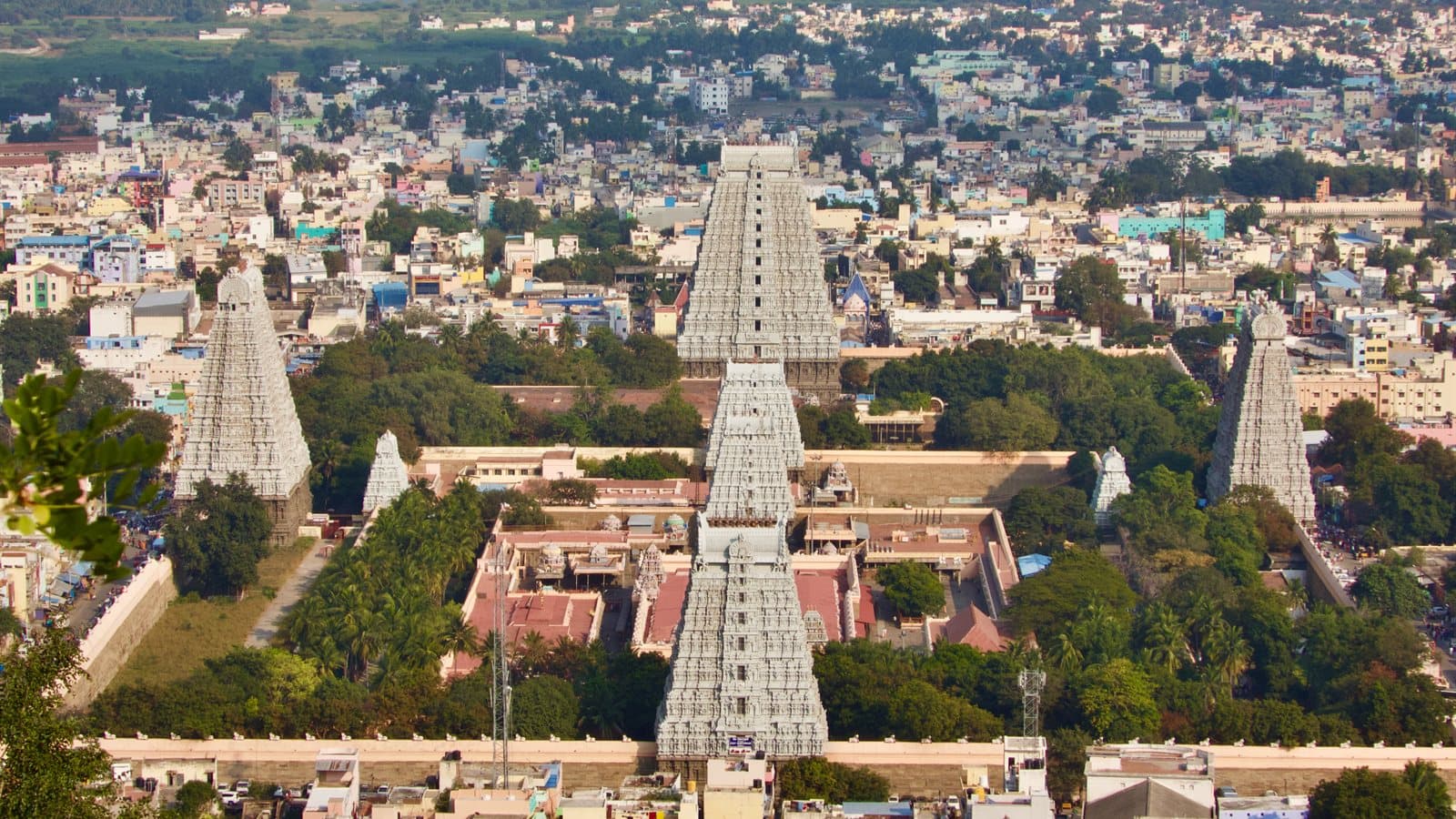
Arunachaleswarar Temple
A Pancha Bhuta Stala representing Fire (Agni Lingam). The holy Arunachala hill is itself considered a manifestation of Shiva. The Karthigai Deepam beacon is visible for miles.
Official WebsiteHistory
Arunachaleswarar Temple at Tiruvannamalai is dedicated to Lord Shiva as Arunachaleswarar (also Annamalaiyar), worshipped as the Agni Lingam, the fire among the Pancha Bhuta Sthalams, with his consort as Unnamulai Amman (Apeetakuchamba). The sanctity of the site rests on Arunachala hill itself, held to be Shiva manifest as an infinite column of fire. References to the shrine appear in early Tamil Sangam literature, and it is celebrated as a Paadal Petra Sthalam in the 7th-century Thevaram hymns of Sambandar, Appar and Sundarar. The vast temple that stands today, spread over about 25 acres, was built up across centuries of royal patronage, the Cholas, the Hoysalas, and above all the Vijayanagara emperors, with Krishnadevaraya raising the towering eastern Rajagopuram and the thousand-pillar hall in the early 16th century. The temple is administered by the Hindu Religious and Charitable Endowments (HR&CE) Department of Tamil Nadu. In the modern era the hill and temple drew the sage Sri Ramana Maharshi, who as a youth meditated in the temple's underground Patala Lingam and spent the rest of his life at the foot of Arunachala, making Tiruvannamalai a global centre of pilgrimage and self-enquiry.
Mythology & Legend
The Legend
The founding legend of Arunachala is the Lingodbhava, the appearance of Shiva as a limitless column of fire. Brahma, the creator, and Vishnu, the preserver, once fell into dispute over which of them was supreme. As they argued, an endless blazing pillar of light pierced the cosmos before them, with neither top nor bottom. To settle the matter they agreed to find its ends: Vishnu took the form of a boar (Varaha) and burrowed downward to seek the base, while Brahma took the form of a swan (Hamsa) and flew upward to seek the summit. After ages of searching neither could reach an end. Vishnu returned and honestly admitted defeat; but Brahma, unwilling to lose, falsely claimed he had touched the top, producing a thazhambu (screw-pine) flower as a false witness. Shiva then emerged from the fiery column and revealed himself as the source of both. He blessed the truthful Vishnu, but cursed Brahma to have no temples of his own and banished the lying thazhambu flower from his worship. Out of compassion for devotees who could not bear the unending fire, Shiva condensed the column into the hill of Arunachala, so that all might worship and circumambulate him. The hill is therefore Shiva himself, the Agni Lingam, and Karthigai Deepam re-enacts the original blaze of light atop it each year.
The Divine Wedding
The marriage of Lord Arunachaleswarar and Unnamulai Amman is celebrated during the Panguni and Karthigai Brahmotsavams, when the processional bronzes of Shiva and the goddess are richly adorned and brought together for the wedding rite before vast crowds, recalling the goddess's reunion with Shiva after her penance at the hill.
Unnamulai Amman and the Play of Closing Shiva's Eyes
Once, in playful affection at Mount Kailash, Parvati covered Lord Shiva's eyes with her hands. Because Shiva's eyes are the sun, moon and fire that sustain all light, the entire universe was instantly plunged into darkness and the cosmic order ground to a halt. To atone for the calamity caused by her playfulness, Parvati came to Arunachala and performed severe penance under the guidance of the sage Gautama, worshipping the hill. Pleased by her devotion, Shiva accepted her back and absorbed her into the left half of his own body as Ardhanareeswara. As the goddess here, she is venerated as Unnamulai Amman, also called Apeetakuchamba, and her shrine within the temple is one of its most powerful centres of worship.
Ramana Maharshi and the Patala Lingam
In 1896 a sixteen-year-old boy named Venkataraman, drawn by an inner call to Arunachala, arrived at the temple and, in deep absorption, sat for weeks in the dank underground shrine of the Patala Lingam, oblivious even to insects feeding on his flesh. He emerged to become Sri Ramana Maharshi, one of the most revered sages of modern India, who taught the path of self-enquiry ('Who am I?') and never again left Arunachala. His ashram, Sri Ramanasramam, at the foot of the hill, and the meditation caves on its slopes draw seekers from around the world, making Tiruvannamalai a meeting point of ancient temple worship and living spiritual practice.
Architecture
Arunachaleswarar is one of the largest temple complexes in India, covering roughly 25 acres at the eastern foot of Arunachala hill, laid out in classic Dravidian style with four massive gopurams facing the cardinal directions. The eastern Rajagopuram, raised by the Vijayanagara emperor Krishnadevaraya, soars to about 66 m across eleven tiers, making it one of the tallest temple towers in India. Within the concentric prakaram walls lie the main sanctum of the Agni Lingam, the Unnamulai Amman shrine, the great thousand-pillar mandapam (Krishnadevaraya's hall), the Kalyana Mandapam, the Shivaganga and Brahma theertham tanks, and the underground Patala Lingam shrine associated with Ramana Maharshi. The temple is integrated with the hill behind it, so that the true vimana of the deity, devotees say, is Arunachala itself.
East Rajagopuram
gopuramராஜகோபுரம்
The colossal eastern gateway tower, raised by the Vijayanagara emperor Krishnadevaraya in the early 16th century. At about 66 m over eleven tiers it is among the tallest temple gopurams in India, the landmark of Tiruvannamalai visible across the town.
~66 m · 11 tiers · 16th-century Vijayanagara
Arunachala Hill
otherThe roughly 800 m hill rising directly behind the temple, revered as the swayambhu form of Shiva himself, the fire column of the Lingodbhava turned to stone. The 14 km Girivalam path rings its base, and the Karthigai Deepam beacon is lit at its summit.
~800 m · 14 km Girivalam path
Agni Lingam Sanctum
sanctumThe innermost sanctum (garbhagriha) enshrining Shiva as the Agni Lingam, the fire element among the Pancha Bhuta Sthalams. The deity is worshipped with the five daily kala poojas.
Unnamulai Amman Shrine
sanctumஉண்ணாமுலை அம்மன்
The major shrine of the goddess Unnamulai Amman (Apeetakuchamba), a powerful Shakti centre in its own right, focus of the Aadi Pooram and Navaratri celebrations.
Thousand-Pillar Mandapam
mandapamThe great pillared hall built by Krishnadevaraya, its rows of intricately carved granite columns among the finest of Vijayanagara workmanship. The underground Patala Lingam lies near it.
Patala Lingam
otherAn underground subterranean lingam shrine, famed as the spot where the young Sri Ramana Maharshi sat in deep meditation, undisturbed even by vermin. A revered place of stillness within the bustling complex.
Shivaganga Tank
tankThe principal temple tank within the complex, used for ritual bathing and the float festival, fed by the Shivaganga spring. The Brahma theertham is another of the temple's sacred waters.
Ashta Lingams (Girivalam path)
otherEight lingam shrines spaced around the 14 km Girivalam route, each aligned to one of the eight directions and an associated planet (Indra, Agni, Yama, Niruthi, Varuna, Vayu, Kubera, Esanya). Pilgrims worship at each as they circumambulate the hill.
Sub-shrines & Other Deities
Unnamulai Amman
Parvati as ApeetakuchambaThe consort of Arunachaleswarar and the temple's principal goddess, worshipped for grace, marriage and welfare. Her penance at Arunachala and reunion with Shiva is central to the temple's mythology.
Sambandar, Appar & Sundarar
The Nayanmar SaintsThe Thevaram saints who sang this shrine, honoured within the complex as a Paadal Petra Sthalam where their hymns are recited.
Subramanya (Murugan)
Lord Murugan with consortsShrine of Murugan, son of Shiva and Parvati, a customary stop in the temple circuit.
Vinayaka (Ganesha)
Lord GaneshaThe obstacle-remover, worshipped first on entering. Several Vinayaka shrines stand within the vast complex.
Navagraha Shrine
The Nine Planetary DeitiesThe nine planets, worshipped to mitigate planetary afflictions, mirrored on a cosmic scale by the eight Ashta Lingams of the Girivalam path.
Highlights
- 1One of the Pancha Bhuta Sthalams, the temple of the Fire (Agni) element among Shiva's five element-shrines
- 2Arunachala hill itself is revered as a swayambhu manifestation of Shiva, the cosmic column of fire turned to stone
- 3Karthigai Deepam: a giant cauldron of ghee (Maha Deepam) lit atop the 800 m hill, visible for miles, drawing millions
- 4Girivalam: the 14 km barefoot circumambulation of the hill, ringed by the eight Ashta Lingams
- 5One of India's largest temple complexes (~25 acres) with a ~66 m eastern Rajagopuram, among the tallest in the country
- 6A Paadal Petra Sthalam sung in the 7th-century Thevaram of the Nayanmar saints
- 7Deeply linked to Sri Ramana Maharshi, who meditated in the temple's Patala Lingam and settled at Arunachala
Festivals & Events
Karthigai Deepam (Maha Deepam)
November–December (Karthigai)The temple's supreme festival: at dusk on the Karthigai full moon a huge cauldron holding tonnes of ghee is lit atop Arunachala hill as the Maha Deepam, blazing for days and visible for miles, symbolising the cosmic column of fire. The ten-day Karthigai Brahmotsavam leads up to it with daily vahana processions.
Girivalam (Giri Pradakshina)
Every full moon (Pournami)Hundreds of thousands of devotees walk the 14 km path barefoot around Arunachala hill through the night, halting at the eight Ashta Lingams. Chithirai Pournami (April–May) is the most thronged.
Panguni Brahmotsavam
March–April (Panguni)A grand ten-day festival with the deities taken out on different vahanas each day, the chariot (ther) festival and a float festival, distinct from the Karthigai Brahmotsavam.
Maha Shivaratri→
February–March (Masi)The 'great night of Shiva' observed with night-long vigil, four-quarter abhishekams and continuous worship of the Agni Lingam.
Aadi Pooram
July–August (Aadi)Festival dedicated to the goddess Unnamulai Amman, with special abhishekams and alankarams.
Navaratri
September–October (Purattasi)Nine nights honouring the goddess, with daily alankarams of Unnamulai Amman and a Golu doll display.
Sevas & Poojas
Archana
dailyRecitation of the deity's names with flowers and arati, performed in your name and nakshatra. Tickets at the counter inside.
Abhishekam
dailySacred anointing of the Agni Lingam (and of the goddess) with milk, curd, honey, sandal and water during the kala poojas. Can be sponsored at the counter.
Pradosham Pooja
specialThe twilight worship of Shiva on the thirteenth lunar day (Trayodasi), with abhishekam to the Nataraja/Somaskanda bronzes; a highly auspicious and well-attended seva.
Girivalam Worship
specialNot a temple-counter seva but the temple's signature observance: a 14 km barefoot circumambulation of Arunachala hill, halting at the eight Ashta Lingams, performed especially through full-moon nights.
Fees and timings are indicative and may change. Please confirm with the temple office before travelling.