Chidambaram Nataraja
The only temple where Shiva is worshipped as Nataraja — the cosmic dancer. Home to the mystical Chidambara Rahasyam (divine secret) and a key Pancha Bhuta Stalam.
Official WebsiteHistory
The Thillai Nataraja Temple at Chidambaram is one of the most sacred and architecturally significant of all Shiva temples, the very place where Shiva's identity as Nataraja, lord of the cosmic dance, was crystallised. Its ancient name, Thillai, comes from the mangrove forest (Thillai Vanam) that once surrounded it; 'Chidambaram' derives from 'Chit-Ambaram', the 'atmosphere (sky) of consciousness'. Glorified in the Tamil Shaiva canon (by the Nayanmars Appar, Sambandar, Sundarar and by Manikkavasagar, who composed the Tiruvasagam here) and developed across the Pallava, Chola, Pandya and Vijayanagara eras, it became the spiritual heart of Tamil Shaivism. The imperial Cholas treated Nataraja as their tutelary deity and lavished gold on the Chit Sabha. Uniquely, the temple has been administered through its entire history by the Dikshitars, a hereditary community of priest-trustees who trace themselves to 3,000 sages said to have come from Kailash; their independence from government control was reaffirmed by the Supreme Court of India in 2014.
Mythology & Legend
The Legend
The temple's defining event is the Ananda Tandava, Shiva's 'dance of bliss', performed in the Thillai forest for two great sages. Patanjali (the sage of the Yoga Sutras, born in serpent form) and Vyaghrapada, the 'tiger-footed' sage who had been granted tiger's claws and eyes so he could climb the Thillai trees before dawn and gather flowers untouched by bees or men, both longed to behold Shiva's cosmic dance. Pleased by their austerity, Shiva appeared with Sivakami (Parvati) and danced the Ananda Tandava in the golden hall, the very dance now fixed in the bronze Nataraja. In that posture every cosmic function is held in a single form: the drum (damaru) in the upper right hand sounds creation; the fire (agni) in the upper left is dissolution; the lower right hand in abhaya gives protection; the lower left points to the raised foot, the refuge of grace; and beneath the planted foot is crushed Apasmara (Muyalagan), the dwarf of ignorance. Behind it all, the Chidambara Rahasyam (empty space) reveals the formless absolute.
The Dance Contest with Kali (Urdhva Tandava)
The fierce goddess Kali ruled the Thillai forest and would not yield it. To win the ground for his dance, Shiva challenged her to a contest of dance, step for step, in the Nritta Sabha. The two matched each other through every movement until Shiva performed the Urdhva Tandava, lifting one leg straight up toward the sky (in one telling, to retrieve a fallen earring with his toe). Out of modesty Kali, as a woman, would not raise her leg in the same way, and so conceded. Pacified, she took her place at the edge of the town as Thillai Kali, where her own temple stands, while Nataraja's blissful dance reigns at the centre. The chariot-shaped Nritta Sabha marks the spot of the contest.
The Chidambara Rahasyam, the Secret of Space
Beside the Nataraja idol in the Chit Sabha hangs a curtain; when it is drawn for the devout, there is, by design, nothing behind it but empty space, hung with a garland of golden bilva leaves. This is the Chidambara Rahasyam, the 'secret of Chidambaram'. It teaches that the divine is not only the form one can see but the formless, all-pervading consciousness (Akasha) that fills even emptiness. As the Sky element among the Pancha Bhoota Sthalams, Chidambaram worships Shiva as space itself, the lesson that God is everywhere, including where the eye sees nothing.
Shiva and Vishnu Under One Roof
Unusually, Chidambaram is holy to both great streams of Hindu devotion. Within the same complex, the shrine of Govindaraja Perumal enshrines Vishnu reclining on Adisesha, making Chidambaram (as 'Thillai Chithrakoodam') one of the 108 Divya Desams sung by the Vaishnava Alvars, even as Nataraja reigns as the supreme Shaiva deity. Tradition holds that Vishnu witnessed the cosmic dance reclining here. The coexistence has its own storied history, and today devotees of both traditions worship side by side in one of the rare temples sacred to Shaivites and Vaishnavites alike.
Architecture
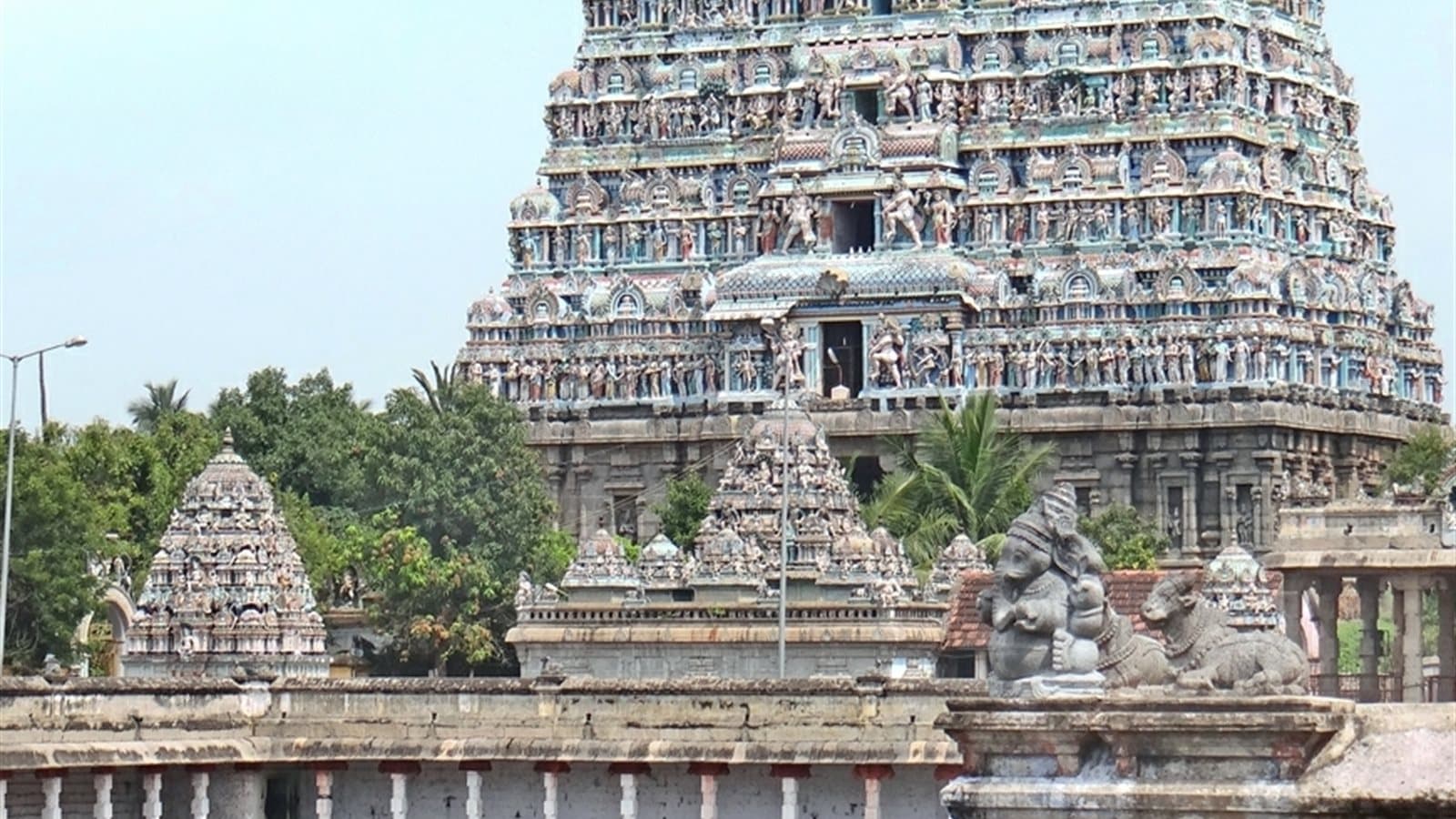
Chidambaram is laid out as a vast walled complex of about 40 acres entered through four towering gopurams facing the cardinal directions, each rising roughly 45 metres in nine tiers. The eastern and western gopurams are celebrated for sculpting the complete set of 108 karanas, the postural 'building blocks' of classical dance described in Bharata's Natya Shastra. At the heart of the temple stand its five sabhas (halls): the Chit Sabha (Ponnambalam), the innermost gold-roofed sanctum where Nataraja dances beside Sivakami, with the Chidambara Rahasyam to its side; the adjoining Kanaka Sabha; the chariot-shaped Nritta Sabha (Natya Sabha) of 56 pillars, scene of the Shiva–Kali dance contest; the Deva Sabha; and the great Raja Sabha or thousand-pillared hall. The Chit Sabha's roof of gold tiles, nine kalasams, the Sivaganga tank, and the separate shrine of Govindaraja Perumal (reclining Vishnu) complete a complex that is at once a Shaiva supreme shrine and a Vaishnava Divya Desam.
Chit Sabha (Ponnambalam)
sanctumசிற்சபை / பொன்னம்பலம்
The innermost, gold-roofed 'Hall of Consciousness' where Nataraja dances the Ananda Tandava beside Sivakami. Its roof of gold tiles is fixed by 72,000 gold nails over 21,600 tiles, symbolising the body's nadis and daily breaths. To the deity's side hangs the curtain of the Chidambara Rahasyam, concealing the sacred empty space.
Gold roof · 21,600 tiles · 72,000 nails
Kanaka Sabha
mandapamThe golden hall immediately before the Chit Sabha, from which the priests perform the worship and abhishekam of Nataraja. Men remove their shirts to ascend the steps to these inner halls.
Nritta Sabha (Natya Sabha)
mandapamநிருத்த சபை
The 'Hall of Dance', carved in the form of a great chariot with wheels and horses, supported by 56 ornate pillars. It marks the site of the dance contest between Shiva and Kali and contains a sculpture of Shiva in the rare Urdhva Tandava pose.
Chariot-shaped · 56 pillars
East Gopuram (108 Karanas)
gopuramகிழக்கு கோபுரம்
One of four ~45 m, nine-tiered gateway towers. The passage walls of the eastern (and western) gopuram sculpt the full set of 108 karanas, the codified postures of Bharatanatyam from the Natya Shastra, a unique stone treatise on classical dance.
~45 m · 9 tiers · 108 karanas carved
Raja Sabha (Thousand-Pillar Hall)
mandapamThe great Raja Sabha, the thousand-pillared hall where the deity is seated and bathed during the grand Arudra and Aani abhishekam festivals. A vast Chola-era ceremonial space.
1,000-pillar hall
Sivaganga Tank
tankThe temple's sacred tank within the complex, beside the shrine of Sivakami Amman, where devotees bathe and from which water is drawn for rituals.
Govindaraja Perumal Shrine
otherThe shrine of reclining Vishnu (Govindaraja) within the complex, a full Divya Desam in its own right, sung by the Alvars, the reason Chidambaram is sacred to Vaishnavites as well as Shaivites.
Sub-shrines & Other Deities
Sivakami Amman
Goddess Parvati, consort of NatarajaThe presiding Goddess, who witnesses the Ananda Tandava beside the Lord in the Chit Sabha and has her own large shrine beside the Sivaganga tank, worshipped as the divine mother of the temple.
Govindaraja Perumal
Lord Vishnu, reclining on AdiseshaThe Vishnu shrine that makes Chidambaram a Divya Desam (Thillai Chithrakoodam). Govindaraja reclines near the Nataraja sanctum, worshipped by Vaishnavites in the same complex as the Shaiva Lord of the Dance.
Thillai Kali
Goddess KaliEnshrined at the northern edge of the town after conceding the dance contest to Shiva, Thillai Kaliamman is closely bound to the temple's central legend and visited as part of a full Chidambaram pilgrimage.
Mukkuruni Vinayagar & Murugan
Lord Ganesha and Lord MuruganThe large Mukkuruni Vinayagar (Ganesha) and the shrine of Murugan (Pandya Nayakam) within the complex, worshipped by devotees on the way to the inner halls.
Ratnasabhapathi & Crystal Lingam
Nataraja in ruby; ChandramouleeswararA small ruby (Ratnasabhapathi) Nataraja and a crystal (spatika) lingam, Chandramouleeswarar, are brought out for special abhishekams, exquisite forms of the Lord reserved for particular rituals.
Highlights
- 1The only temple where Shiva is enshrined and worshipped as Nataraja, the cosmic dancer, in the Ananda Tandava pose codified here
- 2The Akasha (Sky/Space) sthalam among the Pancha Bhoota Sthalams: Shiva worshipped as formless ether
- 3Home of the Chidambara Rahasyam: behind a curtain in the Chit Sabha lies empty space, the formless (Nirguna) divine, the temple's 'secret'
- 4A rare temple sacred to both Shaivites and Vaishnavites: it enshrines Govindaraja Perumal (reclining Vishnu), making it one of the 108 Divya Desams as well
- 5The golden Chit Sabha roof is laid with 21,600 gold tiles fixed by 72,000 gold nails, symbolising the breaths and nadis of the human body
- 6The East Gopuram's inner walls carve all 108 karanas, the fundamental units of classical Bharatanatyam from the Natya Shastra
- 7Administered for centuries by the hereditary Dikshitar priests (the 'Thillai Moovayiravar', the 3,000), independent of state control
Festivals & Events
Margazhi Thiruvadirai (Arudra Darshanam)
December–January (Margazhi)The greatest festival, celebrating the Ananda Tandava on the Arudra (Thiruvadirai) star. A grand abhishekam bathes the bronze Nataraja, the deities are drawn through the streets on the great temple car (ther), and lakhs of devotees gather for the dawn darshan of the dancing Lord.
Aani Thirumanjanam
June–July (Aani)The second of the temple's two grandest abhishekam festivals, on the Uttiram star of Aani, with a ceremonial car festival and the sacred bathing of Nataraja in the Raja Sabha, equal in importance to Arudra Darshanam.
Natyanjali Dance Festival
February–March (Maha Shivaratri)A five-day festival in which Bharatanatyam and other classical dancers from across India perform before Nataraja as a devotional offering, 'anjali' (homage) through 'natya' (dance), in the temple of the cosmic dancer himself.
Maha Shivaratri→
February–March (Masi)The Great Night of Shiva, observed with one of the temple's six annual abhishekams and night-long worship of the Lord of the Dance.
Sevas & Poojas
Nataraja Abhishekam
specialThe sacred bathing of the bronze Nataraja, performed only six times a year (chiefly at Margazhi Thiruvadirai and Aani Thirumanjanam) because the processional bronze cannot be bathed daily, making each abhishekam a rare and thronged spectacle in the Raja Sabha.
Archana at the Chit Sabha
dailyOffering of the devotee's name and birth-star with flowers and the recitation of the Lord's names, performed by the Dikshitar priests at the golden hall.
Chidambara Rahasyam Darshan
dailyThe drawing of the curtain beside Nataraja to reveal the sacred empty space, the formless divine, at the priests' discretion, especially during the deeparadhana, the most contemplative moment of a Chidambaram visit.
Deeparadhana (Lamp Worship)
dailyThe waving of camphor and lamps before Nataraja and the Rahasyam, when the gold hall glows and the assembled devotees behold the dancing Lord amid fire and bells.
Ardha Jama (Palliyarai) Pooja
dailyThe final worship of the day, when the Lord is ceremonially escorted to rest with lullabies, a gentle, intimate close to the temple's daily cycle.
Fees and timings are indicative and may change. Please confirm with the temple office before travelling.