History
The Sarangapani Temple at Kumbakonam, known in the Tamil hymns as Thirukudanthai, is among the foremost of the 108 Divya Desams and the largest Vishnu temple in the town. It is glorified in the Nalayira Divya Prabandham by several of the Alvars, who sang of the reclining Lord as Aravamudhan, the nectar of which one can never have enough. Here Vishnu is worshipped as Sarangapani, the wielder of the Sarnga bow, who by legend descended from Vaikuntha on a chariot to wed the Goddess Komalavalli, born of the golden lotus tank. The temple is also one of the Pancharanga Kshetrams, the five sacred shrines of the reclining Ranganatha set along the Kaveri. Developed and endowed across the Chola, Vijayanagara and Nayak eras, it grew into the spiritual anchor of Kumbakonam, the temple-town whose great Mahamaham tank draws millions once every twelve years. Through every age the Lord has reclined here in his chariot-shaped shrine, drawing pilgrims and the poet-saints alike.
Mythology & Legend
The Legend
The legend of Sarangapani is the story of how Lakshmi came to earth and Vishnu followed to wed her. The sage Hema Rishi longed for the Goddess Lakshmi to be born as his daughter, and performed a long penance on the banks of the golden lotus tank (Potramarai) at Thirukudanthai. Pleased by his devotion, Lakshmi appeared, rising from the lotus tank as a child, and was raised by the sage as Komalavalli. When she came of age, Vishnu himself descended from Vaikuntha to marry her, arriving at Kumbakonam in great splendour upon a celestial chariot drawn by horses and elephants, as Sarangapani, the bearer of the Sarnga bow. The marriage of Sarangapani and Komalavalli was celebrated here, and the central shrine was built in the form of that very chariot to commemorate the Lord's descent. From this union the temple takes its abiding character as a place of auspicious wedding and grace.
The Divine Wedding
The celestial wedding of Sarangapani and Komalavalli Thayar, the climax of the legend, is re-enacted each year as the high point of the Chithirai Brahmotsavam, when the divine couple are united before the gathered devotees.
Aravamudhan and the Insatiable Nectar
The reclining moolavar of this temple is adored as Aravamudhan, 'the nectar of which one never has enough'. Nammalvar sang of him in the Tiruvaimozhi with the cry 'Aaravamude', overcome by the sweetness of the Lord. A beloved tradition tells of Thirumazhisai Alvar, who worshipped here with his disciple Kanikannan. When a king banished Kanikannan from the town, the Alvar would not stay without his disciple and bade the reclining Lord himself to roll up his serpent-bed and come away with them. The Lord obeyed and rose, and only when the king relented and the Alvar sang to him again did Aravamudhan return to recline once more. The episode is cherished as a proof of how dear true devotees are to the Lord.
The Chariot Sanctum and the Two Doors
Uniquely, the sanctum of Sarangapani is shaped like a chariot, complete with carved stone wheels and teams of horses and elephants, because the Lord is said to have descended on a celestial car to wed Komalavalli. The shrine has two doors. The northern, the Uttarayana Vaasal, is used during the sun's northern course (roughly mid-January to mid-July), and the southern, the Dakshinayana Vaasal, during the southern course (mid-July to mid-January). Pilgrims thus approach the Lord through the door that belongs to the season, a living link between the temple's worship and the turning of the cosmic year.
Kumbakonam and the Mahamaham
Kumbakonam takes its name from the legend of the kumbha, the pot. At the great deluge that ends an age, the pot holding the seed of creation and the nectar of life floated upon the waters and came to rest here; when Shiva, as a hunter, pierced it, the nectar spilled and formed the town's sacred tanks, chief among them the Mahamaham tank. Once every twelve years, when Jupiter is in Leo and the Masi star of Magha shines, the waters of all the holy rivers are believed to converge in that tank, and millions come to bathe in the Mahamaham. Sarangapani, as the great Vishnu temple of the town, sends its deities in procession to the tank, joining the other temples of Kumbakonam in this rarest of pilgrimages.
Architecture
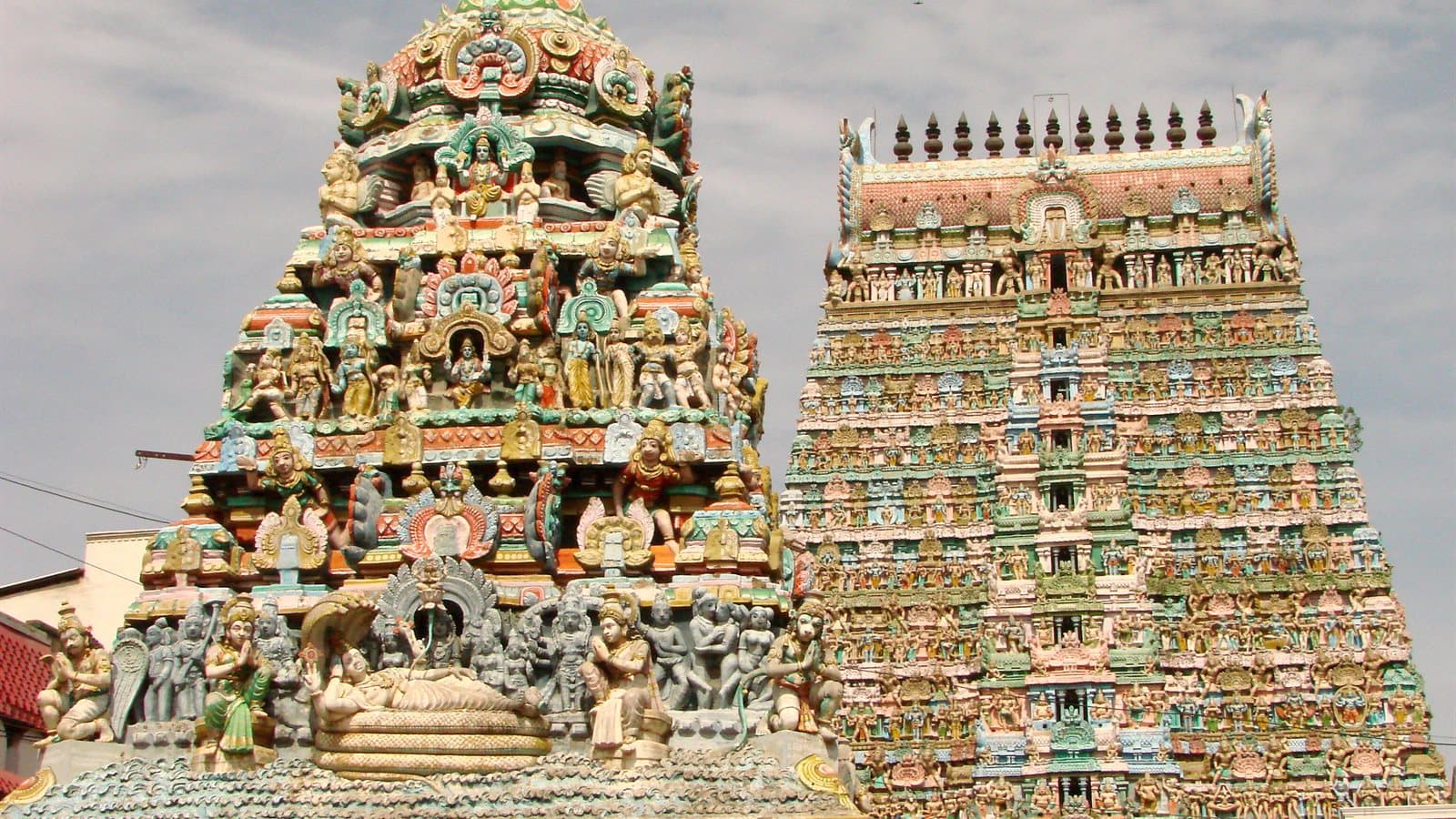
Sarangapani is a large complex entered through a towering eleven-tiered southern Rajagopuram, about 173 feet high, one of the tallest temple towers in the region. The temple's most striking feature is the central shrine itself, the Thiru Aravamudhan sannidhi, fashioned in the shape of a chariot (ratha): the sanctum is flanked by great carved stone wheels and drawn by sculpted horses and elephants, evoking the celestial car on which Sarangapani came down to marry Komalavalli. The shrine has two doorways, the Uttarayana Vaasal to the north and the Dakshinayana Vaasal to the south, opened in turn for the two halves of the solar year. Within reclines the moolavar Aravamudhan, with the processional Sarangapani as the utsava deity. The Goddess Komalavalli Thayar has her own shrine, and the temple holds the Hema Pushkarani (Potramarai) tank, long pillared mandapams and the fine delta-style sculpture of its successive royal patrons.
Southern Rajagopuram
gopuramThe towering eleven-tiered southern gateway, rising about 173 feet, among the tallest temple towers in the Kaveri region and the great landmark of the temple, ornamented with tier upon tier of stucco figures.
~173 ft · 11 tiers
Chariot Sanctum (Thiru Aravamudhan)
vimanaThe central shrine built in the form of a chariot, flanked by carved stone wheels and drawn by sculpted horses and elephants, recalling the celestial car on which Sarangapani descended. Within reclines the moolavar Aravamudhan.
Chariot-shaped · wheels, horses, elephants
Uttarayana & Dakshinayana Vaasal
otherThe two doors of the sanctum, opened in turn for the two halves of the solar year: the northern Uttarayana Vaasal during the sun's northern course, and the southern Dakshinayana Vaasal during the southern course.
Two seasonal doorways
Komalavalli Thayar Shrine
sanctumThe shrine of the Goddess Komalavalli, Lakshmi born of the golden lotus tank and wedded to Sarangapani. Worshipped by devotees for prosperity, auspicious marriage and family welfare.
Hema Pushkarani (Potramarai Tank)
tankThe golden lotus tank from which Komalavalli Thayar is said to have risen, named for the sage Hema Rishi whose penance brought the Goddess to earth. A sacred bathing tank within the temple precinct.
The golden lotus tank
Festival Mandapams
mandapamLong pillared halls and festival pavilions used for the Brahmotsavam, the float festival and the daily processions, carved in the delta style of the temple's Chola, Vijayanagara and Nayak patrons.
Sub-shrines & Other Deities
Komalavalli Thayar
Goddess Lakshmi as KomalavalliThe presiding Goddess, born of the golden lotus tank and wedded to Sarangapani, with her own shrine; sought for prosperity, marriage and family welfare.
Chakkarathazhwar
Sudarshana, the discus of VishnuThe personified discus of the Lord, worshipped for protection and the warding off of evil, with his shrine in the complex.
Andal
Andal, the Alvar GoddessThe girl-saint who sang the Tiruppavai and was united with the Lord, honoured here as in every great Vishnu temple, especially during Margazhi.
Hema Rishi & the Alvars
The sage Hema Rishi and the Alvar poet-saintsHema Rishi, whose penance brought Komalavalli to earth, and the Alvars who sang of Aravamudhan, are venerated within the temple that their devotion made famous.
Highlights
- 1One of the 108 Divya Desams (Thirukudanthai), sung by the Alvars; the reclining Lord is adored as Aravamudhan, 'the insatiable nectar'
- 2The sanctum is built in the form of a great chariot, with carved wheels, horses and elephants, recalling the celestial chariot on which Vishnu descended as Sarangapani
- 3One of the tallest temple towers in the region: the eleven-tiered southern Rajagopuram, rising about 173 feet
- 4Two entrances used in the two halves of the year: the Uttarayana Vaasal (north) and the Dakshinayana Vaasal (south)
- 5The anchor temple of the sacred Kumbakonam cluster and a focus of the Mahamaham, held once every twelve years
- 6One of the Pancharanga Kshetrams, the five great shrines of Vishnu reclining along the course of the Kaveri
- 7Birthplace of Komalavalli Thayar (Lakshmi), who rose from the Potramarai (golden lotus) tank
Festivals & Events
Chithirai Brahmotsavam
April–May (Chithirai)The grand annual festival, spanning many days with the deities taken out on a succession of vahanas and the great temple car (ther), culminating in the celestial wedding of Sarangapani and Komalavalli.
Vaikunta Ekadasi
December–January (Margazhi)The holiest Vaishnava day, when the Paramapada Vasal (gate of heaven) is opened and devotees pass through it, with special recitation of the Tiruvaimozhi and grand darshan of the Lord.
Mahamaham→
Once every 12 years (Masi)The rarest event of the Kumbakonam calendar, when the sacred rivers are believed to converge in the Mahamaham tank and millions gather to bathe; the temple deities, including Sarangapani, process to the tank for the holy immersion.
Float Festival (Theppam)
January–February (Thai)The deities are taken on an illuminated float across the temple tank on full-moon nights, a serene and much-loved festival of the delta temples.
Sevas & Poojas
Thirumanjanam (Abhishekam)
specialThe ceremonial sacred bathing of the processional Lord with milk, sandal, rosewater and other substances, sponsored by devotees and followed by alankaram and deeparadhana.
Archana (Sahasranama)
dailyOffering of flowers and the recitation of the Lord's names, including the thousand names (Sahasranama), in the devotee's name and birth-star, performed by the temple priests.
Thirukalyana Utsavam
specialSponsorship of the celestial wedding ceremony of Sarangapani and Komalavalli, offered by devotees for marital harmony, timely marriage and family welfare.
Vaikunta Ekadasi Darshan
specialSpecial darshan on the holiest Vaishnava day, when the Paramapada Vasal (gate of heaven) is opened and devotees pass through it for the Lord's grace.
Deeparadhana
dailyThe lamp ceremony at which the Lord is worshipped amid rows of oil lamps, a serene daily highlight open to all worshippers.
Fees and timings are indicative and may change. Please confirm with the temple office before travelling.