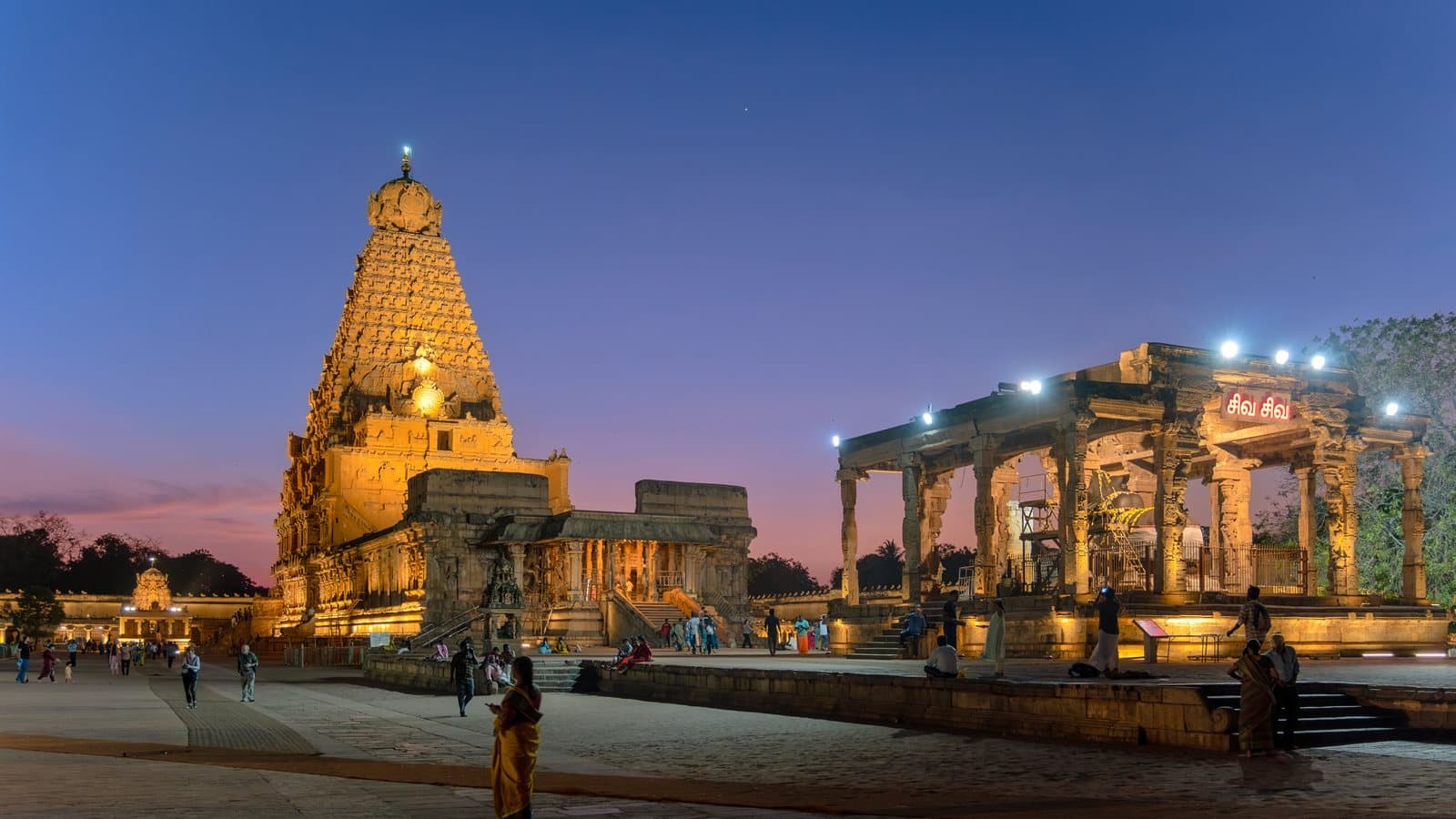
Brihadeeswara Temple
A UNESCO World Heritage Site built by Raja Raja Chola I in 1010 CE. The vimana (tower) rises 66 meters — the tallest in the world at the time of construction.
Official WebsiteHistory
Built by the great Chola Emperor Raja Raja I between 1003–1010 CE, the Brihadeeswara Temple (also called Peruvudaiyar Kovil) is a testament to the zenith of Chola art and architecture. The temple was built to celebrate military victories and royal power. The inscriptions on the walls, over 400 of them, provide detailed records of the Chola empire's administration, donations, and religious practices.
Mythology & Legend
The Legend
Raja Raja Chola I (Arulmozhivarman) had a vision during a military campaign in Sri Lanka: Lord Shiva appeared and instructed him to build a temple worthy of his cosmic stature. Returning to his capital Thanjavur at the height of his empire (he had conquered Kerala, the Pandyan kingdom, parts of Karnataka and northern Sri Lanka), the king resolved to construct a Dakshina Meru, a southern Mount Meru, that would surpass every temple ever built. Construction began in 1003 CE and was completed in 1010 CE: just seven years for a monument of granite weighing over 130,000 tonnes. The temple was consecrated with its main deity named Rajarajeswaram-Udaiyar after the king himself; over the centuries it came to be known by the more universal name Brihadeeswara, 'the Great Lord'.
The Consecration of the Great Lingam
Raja Raja's choice of the saint Karuvur Devar to perform the consecration is itself the temple's defining legend. When the king brought the great Shivalingam to the sanctum and tried to install it, every method failed: the lingam would not rise. Devars assembled in despair. Karuvur Devar, then a wandering Shaiva saint, was summoned. He sang the Tiruvisaippa, a hymn in praise of Brihadeeswara, composed on the spot, and the lingam rose effortlessly into place. Raja Raja built a small shrine for Karuvurar inside the southern prakaram, where the saint remains in worship to this day.
The Mystery of the Shadow
A popular belief holds that the shadow of the temple's 66-metre vimana never falls on the ground, that it 'disappears' at noon. Modern survey work has shown this is partially true and partially mythologised: at midday, the vimana's shadow falls onto its own base rather than extending beyond the temple compound. This is the result of a remarkable architectural calculation by the Chola sthapatis (architects), who designed the tapering pyramid so its centre of mass and shadow geometry align with the base. Whether intentional or accidental, the effect contributes to the structure's mystique, and may have been a deliberate symbolic statement that the king's temple, like the king himself, cast no overshadowing presence on his subjects.
The 80-Tonne Cap Stone
At the top of the vimana sits a single 25-tonne (some accounts say 80-tonne) octagonal cap stone (the sikhara), capped with a kalasham. Local tradition holds that the Chola engineers raised this stone using a six-kilometre-long inclined earthen ramp from the village of Sarapallam ('scaffold-pit village') near modern Thanjavur. Elephants and labourers slowly hauled the stone up the ramp on log rollers. After installation, the entire ramp was dismantled. The feat is among the marvels of ancient engineering: the cap stone was raised to 60 metres without modern machinery, only animal power, ropes, and one of history's great experiments in friction physics.
The Living Bronzes
Raja Raja commissioned dozens of bronze processional images for the temple, cast in the cire perdue (lost-wax) method that Chola sthapatis had perfected. The most exquisite is the Rajaraja-Sundara-Choleswara, a Shiva-Parvati pair where Parvati is said to be modelled on the king's queen, Lokamadevi. These bronzes are still in active worship today, taken in procession on festival days, anointed daily, dressed in fresh silks. They are considered among the finest surviving Chola bronzes in the world.
Architecture
Built entirely of granite, the Brihadeeswara is the world's first complete granite temple. The 66-meter vimana consists of 13 tapered tiers. The massive Shivalingam in the sanctum (8.7 meters tall) is the second largest in India. The outer wall is decorated with sculptures of Shiva in various forms (108 Bharata Natyam poses are depicted).
Brihad-Vimana (Sri Vimana)
vimanaஸ்ரீ விமானம்
The temple's defining feature, a 13-tier granite pyramid rising 66 metres (216 ft) over the sanctum. The tallest temple tower of its era and one of the tallest in India. Each tier diminishes geometrically; the cap stone (sikhara) is a single octagonal granite monolith weighing approximately 25 tonnes.
66 m · 13 tiers · 25-tonne cap stone
Garbhagriha & Mahalingam
sanctumThe square sanctum (~14 m on each side) is two storeys tall internally, housing one of India's largest Shivalingams, an 8.7 m (29 ft) tall granite lingam on a square avudaiyar pedestal. The lingam is so large that priests use specially-built scaffolds to perform abhishekam. The sanctum is unusually deep, allowing devotees to circumambulate the lingam within.
Lingam 8.7 m · sanctum two storeys tall
Nandi Mandapam
mandapamHouses the colossal monolithic Nandi (sacred bull) facing the sanctum, 6 m long × 2.6 m wide × 3.7 m tall, carved from a single block of granite weighing approximately 25 tonnes. It is the second-largest Nandi in India (after Lepakshi). The mandapam itself was added in the 16th century by the Nayaks.
Nandi: 6 × 2.6 × 3.7 m · ~25 tonnes
Keralantakan Tiruvasal
gopuramThe outer eastern gateway, named after Raja Raja's conquest of Kerala (his title was Keralantaka, 'destroyer of the Cheras'). Built in the Chola period, the gateway has a single tier with the original Chola sculptures still intact.
Rajarajan Tiruvasal
gopuramThe inner gateway, named after the founder himself. A three-tiered gopuram of remarkable proportional balance. Its sculptures depict dvarapalakas (gate-guardians), Bhairava forms, and scenes from the Periya Puranam. Unusually for South India, the inner gopuram is taller than the outer.
Maha Mandapam & Ardha Mandapam
mandapamThe two pillared halls between the gateway and the sanctum, used for daily rituals and for displays of the festival bronzes. The pillars carry Chola inscriptions recording donations of land, gold and slaves by the king, his queens, and the merchant guilds. Many of the bronzes housed here are 11th-century originals.
Karandai Inscriptions
otherOver 400 stone inscriptions cover the temple's base mouldings (adhishthana), the most extensive surviving administrative record from the Chola period. They record gifts of villages, sums of gold, quantities of paddy, lists of dancers, musicians, accountants, watchmen, and ritual specialists endowed by Raja Raja and his nobles. The inscriptions are written in early Tamil with Grantha letters for Sanskrit names.
400+ inscriptions · early Tamil + Grantha
Chola Frescoes
otherInside the lower corridor of the vimana, the original 11th-century Chola murals were rediscovered in 1930, preserved under a later Nayak-era overpainting. Both layers are now visible: the deep Chola reds and ochres depict scenes from the life of Sundarar and Nataraja; the Nayak overlay shows lighter palette portraits of saints and donors. The space is dimly-lit; ASI permits only authorised photographers.
81 Karana Sculptures
otherCarved on the niches of the vimana's first storey: 81 of the 108 Bharatanatyam karanas (movement units) described in the Natyashastra. The figures, about 1 m tall, in granite, show the dancer in dynamic mid-pose, accompanied by drummers and singers. They are the earliest complete sculptural catalogue of the karanas anywhere in India.
81 of 108 Natyashastra karanas
Brihannayaki Amman Shrine
otherபெரிய நாயகி அம்மன்
The consort goddess Brihannayaki ('Great Mother') in her own shrine within the northern prakaram. Added by the Pandyas in the 13th century after Chola decline. Her annual Aadi Pooram festival is a major draw.
Subrahmanya Shrine
otherA 17th-century Nayak-era addition in the north-western corner of the prakaram. Despite being centuries younger than the main temple, it is considered one of the finest examples of late Nayak granite sculpture. Its pillared mandapam is rated by art historians as a miniature masterpiece.
Karuvurar Shrine
otherA small shrine in the southern prakaram dedicated to Karuvur Devar, the wandering Shaiva saint whose Tiruvisaippa hymn enabled the consecration of the main lingam. His installation here, alongside the great deity, is a rare honour granted by Raja Raja himself.
Sub-shrines & Other Deities
Brihannayaki Amman
Goddess Parvati as 'The Great Mother'The consort goddess in her own shrine on the northern prakaram, added by the Pandyas in the 13th century. Friday is her special day; the annual Aadi Pooram (July–August) draws thousands of women devotees.
Subrahmanya Swamy
Lord MuruganA late-Nayak (17th c.) shrine in the north-western corner. The pillared mandapam, with finely detailed yali and Bhairava sculptures, is widely regarded as the artistic high point of late Tamil temple architecture.
Chandikeshwara
The Custodian of Shiva TemplesAn original Chola-period shrine on the northern wall of the sanctum. Devotees customarily snap their fingers when passing, a gesture to wake Chandikeshwara (who is said to be eternally meditating) and to attest to the truth of the prayers just offered to Shiva.
Ganapathy
Lord GaneshaAn original Chola shrine immediately to the south of the main entrance, where every devotee first offers prayers before approaching the great lingam.
Dakshinamurthy
Shiva as the Cosmic TeacherCarved into the southern niche of the vimana, a 1.5 m granite sculpture of Shiva as the silent teacher seated under the banyan tree, surrounded by four sages. One of the finest Dakshinamurthy depictions of the Chola period.
Lingodbhavar
Shiva as the Infinite PillarOn the rear (western) niche of the vimana, Shiva emerging from a column of fire whose ends Brahma and Vishnu cannot find, despite their searches as a hamsa and varaha respectively. The scene is rendered with rare iconographic completeness.
Karuvur Devar Shrine
The Saint Karuvur DevarThe 11th-century Shaiva poet-saint whose Tiruvisaippa enabled the original consecration of the temple lingam. His enshrinement alongside the main deity is a unique honour in Chola temple tradition.
Highlights
- 1UNESCO World Heritage Site, one of the 'Great Living Chola Temples'
- 2The 66-meter vimana (tower) is the tallest temple tower of its era (built 1010 CE)
- 3The shadow of the vimana never falls on the ground, a remarkable architectural feat
- 4The massive Nandi (bull) monolith, one of the largest in India at 6 meters
- 5Exceptional Chola-era frescoes, bronzes, and inscriptions inside
Festivals & Events
Maha Shivaratri→
February–MarchAll-night vigil with four prahara abhishekams to the great lingam. Brihadeeswara's vast prakaram is illuminated with thousands of lamps; one of the largest Shivaratri gatherings in Tamil Nadu.
Karthigai Deepam→
November–DecemberThe temple is lit with thousands of clay deepams; a great beacon is lit atop the vimana at dusk, visible across the old city.
Sadayam Vizha (Raja Raja Chola Birthday)→
October–NovemberCommemorates the birthday of Raja Raja Chola I (Sadayam nakshatra in the Tamil month of Aippasi). Revived in 2003 by the Tamil Nadu government as a state-level cultural festival.
Aippasi Brahmotsavam
October–November10-day annual Brahmotsavam with daily processions of the deity on different vahanas through the inner prakaram.
Sevas & Poojas
Thiruvanandal Pooja
dailyThe morning waking ritual, abhishekam to the great lingam with milk, panchamrutham, vibhuti and sandal. Performed by climbing the wooden scaffold to reach the lingam's height. Pilgrims watch from the sanctum entrance.
Kalasandhi Pooja
dailyMid-morning archana with Bilva (bel) leaves and recitation of the Sri Rudram.
Uchikala Pooja
dailyNoon pooja with Maha Naivedyam (food offering). The sanctum is closed shortly after for the afternoon break.
Sayaratchai Pooja
dailyEvening pooja with deepa aradhana and Carnatic vocal recital.
Maha Abhishekam (Sponsored)
specialSpecial sponsored abhishekam to the great lingam with full panchamrutham, navadhanyam, and vibhuti. Sponsors receive prasadam, a framed photograph, and the day's recitation.
Rudra Abhishekam
specialEleven-fold recitation of the Sri Rudram with continuous abhishekam, a powerful ritual recommended for relief from doshas and for fulfilment of major vows.
Pradosha Pooja
monthlyPerformed on Pradosham days (Trayodashi tithi, twice each month). Abhishekam to Shiva between sunset and the first watch of the night, one of the most charged of Shaivite rituals.
Bilva Archana
specialOffering of 108 bel leaves with the chanting of Shiva's 108 names. Especially powerful on Mondays and during Karthigai.
Annadanam Sponsorship
specialSponsor a day of free meals for pilgrims at the temple's annadana hall (north of the prakaram). Conducted simply but warmly.
Brihannayaki Special Archana
weeklyFriday-only sankalpa archana to the consort goddess Brihannayaki in her northern prakaram shrine.
Fees and timings are indicative and may change. Please confirm with the temple office before travelling.