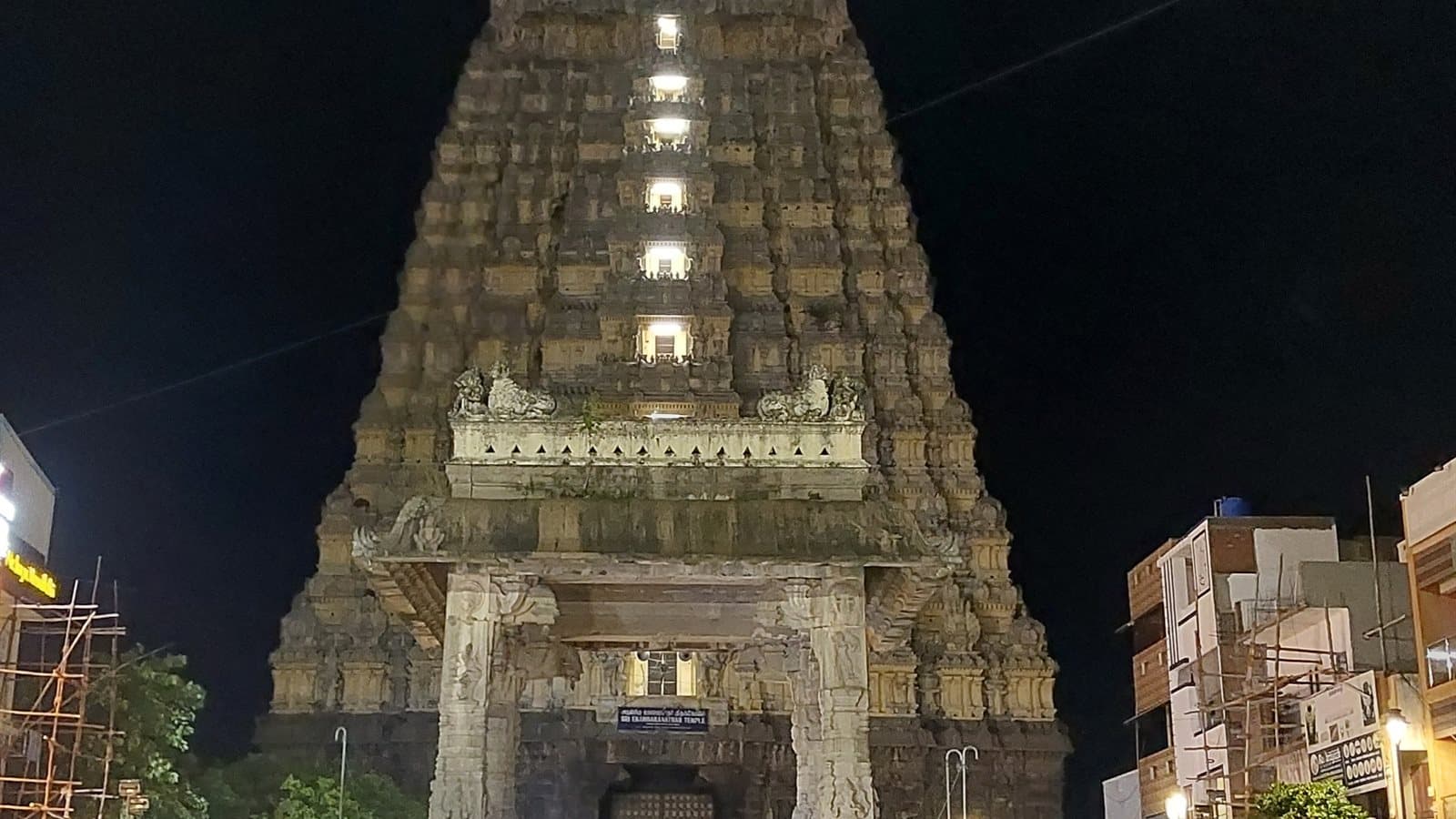
Ekambareswarar Temple
One of the Pancha Bhuta Stalas representing Earth (Prithvi). The ancient mango tree inside is believed to be over 3,500 years old and still bears fruit.
Official WebsiteHistory
The Ekambareswarar Temple is the great Shiva shrine of Kanchipuram and the largest in the city, its sanctity sung in the Tevaram hymns of the Nayanmars Appar, Sambandar and Sundarar, which makes it a Paadal Petra Sthalam. Its name derives from 'Eka-Amra-Nathar', the Lord of the single mango tree, the ancient sthala vruksham that still stands behind the sanctum. Kanchipuram itself is one of the seven sacred Moksha-puris of India and the only one revered by Shaivites and Vaishnavites alike, divided by tradition into Shiva Kanchi and Vishnu Kanchi. The shrine is of great antiquity, developed across the Pallava and Chola eras, but it owes its present grandeur largely to the Vijayanagara emperors: Krishnadevaraya raised the towering eastern Raja Gopuram and the great outer wall in 1509, enclosing the vast complex seen today. Through every age the temple has been worshipped as the Prithvi Sthalam, the earth among the five element-temples, where Shiva is venerated in a lingam of sand that legend says the Goddess herself fashioned.
Mythology & Legend
The Legend
The central legend of Ekambareswarar is the penance of the Goddess beneath the mango tree. Once, in play, Parvati covered the eyes of Shiva on Mount Kailash, and in that instant the light of the worlds was darkened and creation thrown into disorder. To atone, Shiva sent her to the earth to do penance at Kanchipuram. There, on the bank of the Vegavathi (Kampa) river beneath a single great mango tree, Parvati made a lingam of sand and worshipped it with deep devotion. To test her, Shiva sent the river down in a sudden, raging flood. Rather than flee and let the sand lingam dissolve, the Goddess threw her arms around it and held it fast with her whole body, so that the soft lingam took the imprint of her embrace and her bangles. Moved by such love, Shiva appeared, accepted her worship, and married her at Kanchipuram. Because she worshipped him here as a lingam of earth, the shrine became the Prithvi Sthalam, the earth among the five element-temples.
The Divine Wedding
The wedding of Ekambareswarar and the Goddess, the fruit of her penance under the mango tree, is celebrated each year as the climax of the Panguni Uthiram Brahmotsavam, when the divine couple are united before thronging devotees.
The Mango Tree and the Four Vedas
The sthala vruksham of Ekambareswarar is a single ancient mango tree, the 'eka amra' from which the Lord takes his name, said to have stood for more than three thousand years. By tradition its four great branches each bear mangoes of a different taste, and the four are taken to represent the four Vedas. The tree sheltered the Goddess during her penance and is venerated to this day; childless couples in particular pray beneath it for the blessing of children, and its fruit is treasured as a token of grace.
Why the Earth Lingam Is Never Bathed
Because the lingam here is a Prithvi Lingam, formed of sand by the hands of the Goddess, it cannot be subjected to the water abhishekam given to ordinary stone lingams, for water would wear it away. Instead the deity is worshipped with a careful coat of sandalwood and punugu (civet) paste and adorned with flowers. This unique mode of worship is itself a daily reminder that the Lord here is enshrined in the very element of earth.
Prithvi among the Pancha Bhoota Sthalams
Ekambareswarar is one of the five Pancha Bhoota Sthalams, the temples where Shiva is worshipped as each of the five great elements. Here he is the Earth (Prithvi); at Thiruvanaikaval he is Water, at Thiruvannamalai Fire, at Srikalahasti Air, and at Chidambaram Space or Ether. Pilgrims who complete all five are said to grasp that the one Lord pervades the whole material creation, from solid earth to formless sky, and Kanchipuram's sand lingam is the earthly anchor of that great circuit.
Architecture
Ekambareswarar spreads over about 25 acres within five concentric prakarams, making it one of the largest temple complexes in Tamil Nadu. Its dominant landmark is the eastern Raja Gopuram, rising about 59 metres (some 192 feet) over eleven tiers, built by Krishnadevaraya of Vijayanagara and among the tallest gateway towers in South India. Within, the east-facing sanctum enshrines the Prithvi Lingam, a swayambhu mound of sand which, because of its composition, is never given a water abhishekam but is coated with sandal and punugu paste. Directly behind the sanctum grows the ancient mango tree, the sthala vruksham, sheltering a small shrine. The complex holds the Aayiram Kaal Mandapam (thousand-pillared hall), a gallery of 1,008 carved lingams, long pillared corridors, the Sivaganga tank, and the Nilathingal Thundam Perumal shrine, a Vishnu Divya Desam set within the Shiva temple. The outer walls and mandapams carry the fine Vijayanagara-era sculpture for which Kanchipuram is renowned.
Raja Gopuram
gopuramThe soaring eastern gateway tower, about 59 metres tall over eleven tiers, raised by Krishnadevaraya of Vijayanagara in 1509 and ornamented with tier upon tier of stucco figures. It is among the tallest temple towers in South India and the defining silhouette of Kanchipuram.
~59 m · 11 tiers · built 1509
Garbhagriha (Prithvi Lingam)
sanctumThe east-facing inner sanctum holding the swayambhu Earth lingam of sand. Uniquely, it receives no water abhishekam; the Lord is worshipped with sandal and punugu paste, the imprint of the Goddess's embrace remembered in every ritual.
Swayambhu sand lingam · no water abhishekam
The Sacred Mango Tree
otherThe sthala vruksham behind the sanctum, the single ancient mango tree said to be over 3,500 years old, its four branches yielding fruit of four tastes for the four Vedas. Couples pray here for children; the tree is the living heart of the temple's legend.
Said to be 3,500+ years old
Aayiram Kaal Mandapam
mandapamThe thousand-pillared hall, a vast ceremonial pavilion of carved granite columns typical of the Vijayanagara building tradition, used for festivals and gatherings.
Thousand-pillared hall
Gallery of 1,008 Lingams
otherA corridor lined with one thousand and eight small Shiva lingams carved in stone, an expression of the infinitude of Shiva and a focus of circumambulatory worship.
1,008 carved lingams
Sivaganga Tank
tankThe temple's sacred tank within the complex, where devotees bathe and which serves the temple's ceremonial needs, mirroring the great gopuram in its waters.
Sub-shrines & Other Deities
Nilathingal Thundam Perumal
Lord Vishnu (Chandra Choodaperumal)A shrine to Vishnu set within the Shiva temple and counted among the 108 Divya Desams, sung by the Alvars. Its presence inside Ekambareswarar embodies Kanchipuram's rare standing as a city holy to Shaivites and Vaishnavites together.
Kamakshi (the Goddess)
Goddess Parvati as Kamakshi / ElavarkuzhaliThe Goddess who performed penance under the mango tree and was wed to Ekambareswarar. Kanchipuram's presiding Shakti, Kamakshi, is enshrined principally at her own great temple nearby, completing the pilgrimage to the Lord here.
Vinayaka
Lord GaneshaThe obstacle-remover, worshipped first by devotees as they enter, with his shrine in the temple precinct.
Murugan (Subramanya)
Lord Murugan with Valli and DeivanaiThe shrine of the six-faced Murugan, son of Shiva and Parvati, honoured along the prakaram as part of the family of the Lord.
Highlights
- 1One of the Pancha Bhoota Sthalams, representing the Earth (Prithvi) element; the lingam is a swayambhu mound of sand worshipped without any water abhishekam
- 2The sacred sthala vruksham, an ancient mango tree said to be over 3,500 years old, whose four branches yield fruit of four tastes, symbolising the four Vedas
- 3One of the tallest temple towers in South India: the ~59 metre (about 192 ft) Raja Gopuram raised by Krishnadevaraya of Vijayanagara in 1509
- 4Among the largest temple complexes in Tamil Nadu, spread across roughly 25 acres with five prakarams
- 5The place where Goddess Kamakshi (Parvati) embraced the sand lingam to shield it from the flooding Vegavathi river, and was wed to Shiva
- 6Houses the Aayiram Kaal Mandapam (thousand-pillared hall) and a gallery of 1,008 Shiva lingams
- 7Stands in Kanchipuram, one of the seven Moksha-puris and the 'city of a thousand temples', sacred to both Shiva and Vishnu
Festivals & Events
Panguni Uthiram Brahmotsavam
March–April (Panguni)The grandest festival, a multi-day Brahmotsavam culminating in the Thirukalyanam, the celestial wedding of Ekambareswarar and the Goddess, with the deities taken in splendid procession on various vahanas and the temple car.
Maha Shivaratri→
February–March (Masi)The great night of Shiva, observed with night-long vigil, special abhishekams to the Prithvi lingam and continuous worship; one of the holiest occasions in the Shaiva calendar.
Aani Thirumanjanam
June–July (Aani)A ceremonial sacred-bathing festival with special abhishekam and worship of the processional deities, drawing large gatherings to the temple.
Navaratri
September–October (Purattasi)The nine-night festival of the Goddess, observed with the kolu, special alankarams and worship of the Devi alongside the principal shrine.
Sevas & Poojas
Archana (Pushpanjali)
dailyOffering of flowers and recitation of the Lord's names in the devotee's name and birth-star, performed by the temple priests at the sanctum.
Sandal & Punugu Alankaram
dailyThe special adornment of the Earth lingam with sandalwood and punugu paste in place of a water bath, the characteristic worship of the Prithvi Sthalam, sponsored by devotees.
Pradosham Abhishekam
specialThe twice-monthly Pradosham worship of Shiva at dusk on the thirteenth lunar day, with abhishekam to the Nataraja and Somaskanda bronzes and special deeparadhana, considered especially auspicious for Shaivites.
Thirukalyanam Seva
specialSponsorship of the celestial wedding ritual of Ekambareswarar and the Goddess, the heart of the Panguni Uthiram festival, offered by devotees for marital harmony and family welfare.
Deeparadhana
dailyThe lamp ceremony at which the Lord is worshipped amid rows of oil lamps, a serene daily highlight open to all worshippers.
Fees and timings are indicative and may change. Please confirm with the temple office before travelling.