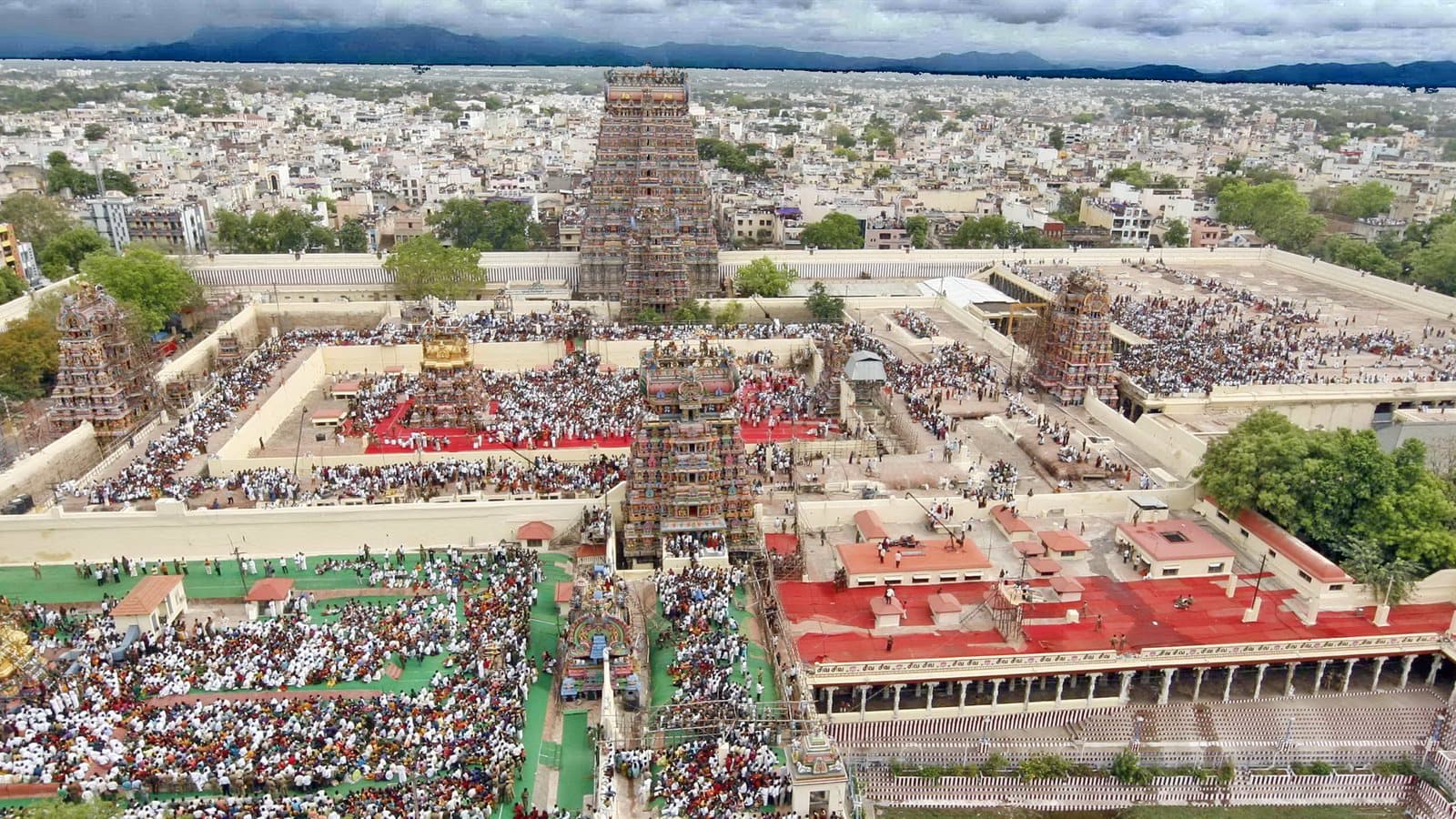
Madurai Meenakshi
A magnificent Dravidian masterpiece with 14 towering gopurams adorned with thousands of colorful sculptures. One of the greatest temples of ancient India.
Official WebsiteHistory
The Meenakshi Amman Temple is one of the oldest and most significant temples in India, with origins dating back over 2,000 years. The current structure was built mainly during the Nayak period (1559–1736 CE). The temple is dedicated to Goddess Meenakshi (a form of Parvati) and her consort Sundareswarar (Shiva). The Chithirai festival celebrates their celestial wedding and is one of the largest temple festivals in South India.
Mythology & Legend
The Legend
King Malayadhwaja Pandyan and Queen Kanchanamala of Madurai were childless despite years of yagnas and prayers. From the sacred fire of a putrakameshti yagna, a three-year-old girl emerged, with three breasts. A divine voice told the worried king to raise her as his own and as a warrior princess: her third breast would disappear the moment she met the man she was destined to marry. The princess was named Thadathagai. She mastered the 64 arts and shastras, succeeded her father as ruler of Madurai, and embarked on a digvijaya (conquest of the directions). On the slopes of Mount Kailasa she met Lord Shiva, and at that very moment, her third breast vanished. She had met her destined husband. Shiva instructed her to return to Madurai, where he would follow as her groom. There she became Meenakshi, 'she of fish-shaped eyes', and reigned as Queen of Madurai before her divine wedding.
The Divine Wedding
Shiva arrived in Madurai as Sundareswarar, 'the beautiful lord', for the wedding. Lord Vishnu, Meenakshi's brother (worshipped at nearby Alagar Kovil as Kallazhagar), travelled from his hill shrine to give the bride away. Brahma performed the ceremony. The wedding was witnessed by all the gods and devas, who assembled in Madurai for the occasion, making Madurai the divine wedding city of Tamil tradition. This Thirukalyanam is re-enacted every year on the ninth day of the Chithirai festival; the chariot procession the following day is one of the largest in South India.
The 64 Thiruvilayadal (Sacred Sports)
Sundareswarar is believed to have performed 64 sacred sports (leelas) in Madurai during his time as king alongside Meenakshi, from selling pearls and gemstones to a poor woman, to teaching Tamil grammar to the sage Agastya, to fighting the Pandyan elephant Madhura Veeran. These 64 leelas are recorded in the Tamil text Thiruvilayadal Puranam by Paranjothi Munivar (17th century) and are re-enacted across 10 evenings during the Aavani Moolam festival.
The Origin of the Name Madurai
When Shiva, pleased with King Kulashekara Pandyan's devotion, shook drops of nectar (madhu) from his matted hair onto the city below, it became known as Madhurai, 'the city of nectar'. Over centuries the name became Madurai. The temple complex sits at the centre of Madurai's concentric old-city street plan, the Adi, Chithirai, Avani Moola and Masi streets, laid out as a lotus around the goddess.
Architecture
A supreme example of Dravidian architecture. The 14 gopurams are the most distinctive feature, with the tallest being the southern tower at 52 meters. Each gopuram is covered in thousands of painted plaster figurines depicting deities, animals, and mythological scenes. The inner sanctums of both Meenakshi and Sundareswarar are separate but connected by corridors.
South Tower (Rajagopuram)
gopuramதென் கோபுரம்
The tallest and most iconic gopuram. Built in the late 16th century by Sevvanthimurthi Chetti.
Height ~52 m · 9 tiers · ~1,500 stucco figures
East Tower
gopuramகிழக்கு கோபுரம்
The original gateway to the Sundareswarar shrine, the main entry for most pilgrims.
Height ~45 m · built c. 1216 CE by Maravarman Sundara Pandyan
West Tower
gopuramமேற்கு கோபுரம்
Faces the Pottramarai Kulam side; one of the four directional gateways.
Height ~50 m
North Tower
gopuramவடக்கு கோபுரம்
The shortest of the four cardinal gopurams.
Height ~46 m · later additions and restorations through the 18th century
Ashta Shakti Mandapam
mandapamஅஷ்ட சக்தி மண்டபம்
The entrance hall just inside the East Tower. Its pillars feature exquisite sculptures of the eight Shaktis (forms of the divine feminine), Brahmi, Vaishnavi, Maheshwari, Indrani, Kaumari, Varahi, Chamundi and Mahalakshmi.
Meenakshi Nayakkar Mandapam
mandapamமீனாட்சி நாயக்கர் மண்டபம்
A 16th-century hall named after Visvanatha Nayaka. Famed for its 985 elaborately-sculpted pillars, each a single granite monolith, depicting yalis, deities, and royal patrons.
985 pillars · Nayak period (1559–1736)
Hall of 1000 Pillars (Ayiram Kaal Mandapam)
mandapamஆயிரம் கால் மண்டபம்
Located in the north-east corner of the complex, this 16th-century hall is now the Temple Art Museum. The pillars are arranged so that whichever way you look, they appear in a straight line. Sculptures include Rati on a parrot, the goddess Meenakshi herself, and royal portraits.
Actually 985 pillars · built 1569 CE by Ariyanatha Mudaliar
Musical Pillars
otherசங்கீத கம்பங்கள்
A cluster of monolithic granite pillars near the entrance to the Hall of 1000 Pillars. When struck gently, each pillar produces a different musical note, the seven swaras of Carnatic music. A surviving testament to Nayak-era acoustic engineering.
Pottramarai Kulam (Golden Lotus Tank)
tankபொற்றாமரை குளம்
The sacred tank inside the complex, ringed by a colonnade. Believed to be where Indra bathed a golden lotus before worshipping the original Sundareswarar lingam. Tamil literary tradition holds that a Sangam of Tamil poets used to convene on its banks: the manuscripts of accepted compositions floated, while the rejected ones sank.
~50 m × 36 m
Killi (Kilikoondu) Mandapam
mandapamகிளிக்கூண்டு மண்டபம்
The 'Parrot Cage' hall, between the second corridor and the goddess's sanctum. Until the late 20th century, hundreds of trained green parrots were kept here, taught to say 'Meenakshi'. The practice was discontinued for the birds' welfare; the cages still stand as a heritage feature.
Sundareswarar Vimana
vimanaசுந்தரேஸ்வரர் விமானம்
The gold-plated tower (vimana) directly above the Shiva sanctum. Gilded again during the most recent Kumbabhishekam (consecration) in 2009.
Meenakshi Vimana
vimanaமீனாட்சி விமானம்
The gold-plated vimana over the Meenakshi sanctum, where the goddess stands in the green emerald form holding a parrot.
Sub-shrines & Other Deities
Mukkuruni Vinayakar
Lord GaneshaA massive Ganesha murti carved from a single granite monolith, discovered during the excavation of the Mariamman Teppakulam tank. 'Mukkuruni' refers to the three-kuruni (~12 litre) measure of rice needed for his daily abhishekam.
Subrahmanya Shrine
Lord MuruganShrine to Murugan with his consorts Valli and Devasena. Special significance during the Tamil month of Panguni (March–April) and on Krittika nakshatram days.
Navagraha Shrine
The Nine Planetary DeitiesArranged in the traditional grid with Surya at the centre. Devotees circumambulate the nine planets to seek relief from astrological doshas.
63 Nayanmars
Tamil Shaivite SaintsLife-size bronze statues of the 63 Nayanmars line the corridor leading to the Sundareswarar sanctum. They are taken in procession during the Arubathumoovar festival, mirroring the famous Mylapore celebration.
Durga Shrine
Goddess Durga (as Mahishasuramardini)Located in the corridor around the Meenakshi shrine. Worshipped particularly during Navaratri.
Lakshmi & Saraswati Shrines
The Goddesses of Wealth and WisdomSub-shrines flanking the path between the two main sanctums, completing the Tridevi worship within the complex.
Natarajar Sabha
Shiva as Cosmic DancerA special sabha (dance hall) housing a bronze Nataraja. Unusually, here the dancing pose is reversed: Nataraja's right leg is raised instead of the left, said to be at the request of a Pandyan king who wished to see the cosmic dance from the other side.
Highlights
- 114 gateway towers (gopurams) rising up to 52 meters, covered in colorful stucco figures
- 2Over 33,000 sculptures adorning the temple complex
- 3The sacred Porthamarai Kulam (Golden Lotus Tank) inside the complex
- 4The Meenakshi Nayakar Mandapam with 985 pillars
- 5The unique fish-eye (meena-akshi) form of Goddess Parvati
Festivals & Events
Chithirai Festival→
April–May18-day festival celebrating the divine wedding of Meenakshi and Sundareswarar. Draws over a million devotees.
Aavani Moolam→
August–September10-day festival re-enacting the 64 sacred sports (Thiruvilayadal) of Lord Sundareswarar. Each evening features a different leela.
Navaratri Golu→
September–OctoberNine nights of the Goddess. The temple displays an elaborate golu (doll arrangement) and special alankarams of Meenakshi as the nine forms of Devi.
Float Festival (Theppam)→
January–FebruaryOn Thai Poosam full moon, the deities are taken on an illuminated float across the Mariamman Teppakulam tank, a 1 km tank 5 km from the temple.
Karthigai Deepam→
November–DecemberThe temple is lit with thousands of clay lamps; special abhishekam to Sundareswarar at dusk.
Sevas & Poojas
Kalasandhi Pooja
dailyFirst major pooja of the morning, abhishekam to both Meenakshi and Sundareswarar with milk, curd, honey, sandal, and panchamrutham.
Uchikala Pooja
dailyMidday pooja followed by Maha Naivedyam (food offering) to the deities.
Sayaratchai Pooja
dailyEvening pooja with full alankaram (decoration) of the goddess.
Ardhajama Pooja (Palliyarai Seva)
dailyThe night pooja: the deities are taken in procession to the Palliyarai (bedchamber) on a silver palanquin. One of the most cherished darshans for devotees.
Friday Special Pooja
weeklyMeenakshi is given a grand abhishekam and dressed in a special saree. Fridays draw the largest weekday crowd.
Pradosha Abhishekam
monthlyPerformed twice each month on Pradosham days (Trayodashi tithi). Special abhishekam to Sundareswarar between sunset and nightfall.
Pournami Abhishekam
monthlyFull-moon-day abhishekam to Meenakshi with 108 conches of holy water. Booking essential.
Sahasranama Archana
specialRecitation of the 1,000 names of Meenakshi with archana, performed at the goddess shrine.
Thirukalyanam (Wedding Seva)
specialSponsorship of the symbolic celestial wedding of Meenakshi and Sundareswarar. Sponsors receive prasadam and a wedding cloth (madisar).
Annadanam Sponsorship
specialSponsor a day of free meals for pilgrims. The temple trust serves anna danam at the dining hall near the East gate.
Fees and timings are indicative and may change. Please confirm with the temple office before travelling.