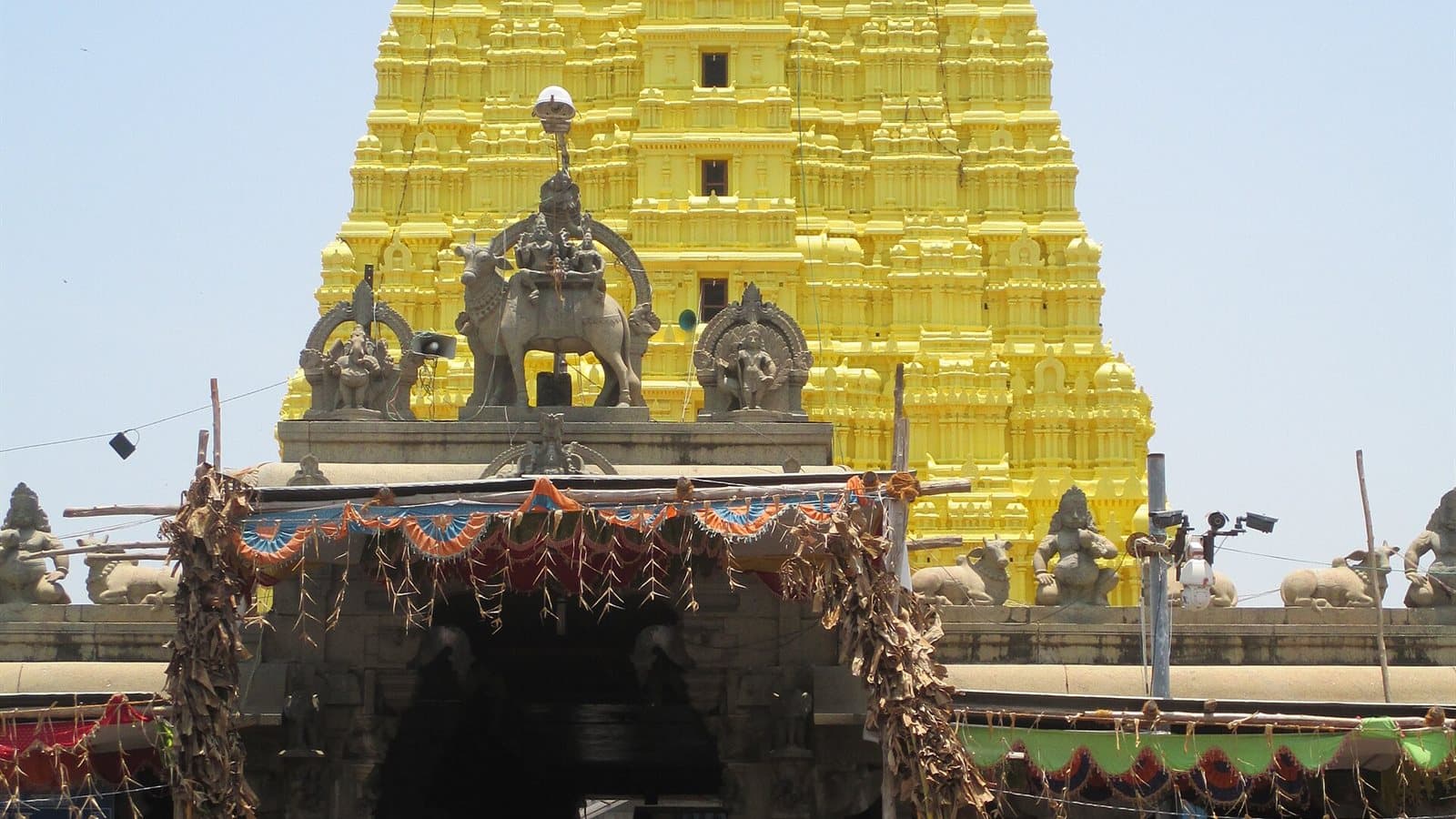
Ramanathaswamy Temple
One of the 12 Jyotirlingas, located on Pamban Island. Famous for its magnificent corridors — the longest in any Hindu temple — and 22 sacred theerthams.
Official WebsiteHistory
Rameswaram is among the holiest sites in Hinduism, sacred to both Shaivites and Vaishnavites, which is rare. According to the Ramayana, Lord Rama worshipped Shiva here to absolve the sin of Brahmahatya (the killing of Ravana, a learned Brahmin) on his return from Lanka. The temple is one of the 275 Paadal Petra Sthalams glorified in the Tevaram hymns of the Nayanmar saints. While the site's sanctity is ancient, the present stone temple was built and expanded over four centuries (12th–17th c.) chiefly by the Setupati kings of Ramanathapuram, with major additions by the Pandyas, the Jaffna kings of Sri Lanka, and later mercantile patrons. The towering east Rajagopuram was completed only in the 20th century.
Mythology & Legend
The Legend
After slaying Ravana and rescuing Sita, Lord Rama stood burdened by Brahmahatya dosha, the gravest of sins, for Ravana was a Brahmin and a great devotee of Shiva. On the advice of the sages, Rama resolved to worship Shiva on the shore where his army had crossed to Lanka. He sent Hanuman to Mount Kailash to fetch a lingam, but the auspicious muhurta for installation drew near and Hanuman had not returned. So Sita moulded a lingam from the beach sand with her own hands, and Rama consecrated it. This is the Ramalingam, the principal deity Ramanathaswamy ('the Lord whose master is Rama'). When Hanuman arrived with the lingam from Kailash (the Vishwalingam) and was grieved to find another already installed, Rama consoled him by decreeing that the Vishwalingam, also called Kasilingam, would always be worshipped first, before the Ramalingam. That order of worship is honoured in the temple to this very day.
The Divine Wedding
The celestial marriage of Lord Ramanathaswamy and Goddess Parvathavardhini is re-enacted each year at Vasanthotsavam (May–June). The processional bronzes of the divine couple are borne in splendour through the temple's vast corridors, recalling the eternal union of Shiva and Shakti that the lingam at Rameswaram embodies.
Hanuman, the Well of Atonement, and the Order of Worship
Hanuman's lingam from Kailash could not be moved once Sita's sand lingam was installed; by one account he tried to uproot the Ramalingam with his tail and failed, the mark of his tail still shown on it. Rama's decree that the Vishwalingam be worshipped first turned a moment of disappointment into an everlasting honour for Hanuman. Both lingams stand together in the sanctum, and the temple is thus sacred to the bhakti of the greatest devotee as much as to the penance of the avatar himself.
The Sethu, the Bridge of Floating Stones
From the southern tip of the island at Dhanushkodi, Rama's vanara army built the Sethu (Ram Setu / Adam's Bridge) of floating stones to cross to Lanka, the stones bearing Rama's name. Bathing at the Sethu and at Dhanushkodi, where the Bay of Bengal meets the Indian Ocean, is part of the Rameswaram pilgrimage. It is said that on his return Rama broke the bridge with the end of his bow (dhanush-kodi, 'the bow's end') so it could never again be crossed.
Kashi and Rameswaram, the Two Poles of Pilgrimage
A pilgrimage to Kashi (Varanasi) is held to be incomplete without Rameswaram, and vice-versa. The classic Sethu Yatra binds them: the pilgrim carries Ganga water from Kashi to bathe the Ramalingam at Rameswaram, and carries sand from Rameswaram to immerse in the Ganga. The two shrines, the northern and the southern, are seen as the spiritual poles of the subcontinent, linking the Himalayan Ganga to the southern sea.
The Twenty-Two Theerthams
The Skanda Purana and local tradition hold that Rama created the sacred wells by shooting arrows into the earth to draw out the waters of the holy rivers, so his pilgrims would not have to travel to each one. Each of the 22 theerthams is identified with a sacred water or virtue, among them Mahalakshmi, Savitri, Gayatri, Saraswathi, Surya, Chandra, Ganga, Yamuna and the Brahmahatya Vimochana ('release from the sin of Brahmahatya') theertham. Bathing in all 22, well by well, washes away accumulated sins and is the ritual core of the Rameswaram pilgrimage.
Architecture
Ramanathaswamy is the supreme example of Dravidian corridor architecture. Its three concentric prakarams (corridors) culminate in the third, the longest temple corridor in India, around 1,220 metres in total, lined with more than 1,200 granite pillars about 9 metres tall, each carved with bracket figures and rearing yalis. The pillars create a famous receding optical perspective. The temple has a 53-metre east Rajagopuram and a lower western gopuram. Within lie the twin sanctums of Ramanathaswamy (the Ramalingam) and the Vishwalingam, the Parvathavardhini Amman shrine, the Sethu Madhava (Vishnu) shrine, and the 22 theertham wells distributed across the prakarams.
Third Prakaram (The Great Corridor)
mandapamமூன்றாம் பிரகாரம்
The temple's crowning glory and the longest corridor in any Hindu temple, roughly 1,220 metres in total length around the complex, lined with over 1,200 granite pillars rising about 9 metres. The pillars stand on raised platforms with elaborate bracket figures and rearing yalis; the long colonnade produces a celebrated receding optical perspective. Built largely under the Setupati kings in the 17th–18th centuries.
~1,220 m · 1,200+ pillars · ~9 m high
Garbhagriha, Ramalingam & Vishwalingam
sanctumThe inner sanctum houses two lingams: the Ramalingam (Ramanathaswamy), moulded from sand by Sita and the principal deity; and the Vishwalingam (Kasilingam) brought by Hanuman from Kailash, which by Rama's own decree is worshipped first. Abhishekam is performed with Ganga water brought by pilgrims, and the Sparisa darshan allows devotees to touch the lingam at appointed hours.
Twin lingams · Vishwalingam worshipped first
East Rajagopuram
gopuramThe towering eastern gateway rises about 53 metres (126 ft) in nine tiers, the tallest of the temple's towers. Though the temple is centuries old, this great gopuram was completed only in the 20th century, its stucco figures vividly painted. It is the first sight of the temple for pilgrims arriving from the railway station and the sea.
~53 m · 9 tiers
West Gopuram
gopuramThe western gateway, lower than the east tower, opens toward the Setu Madhava shrine side of the complex. Together the two main gopurams and the inner gopurams frame the long axis along which the corridors run.
Nandi Mandapam
mandapamA large monolithic Nandi about 5.5 metres long and 3.6 metres tall faces the sanctum from the eastern approach, set in its own pillared hall. As at every Shiva temple, devotees offer prayers to Nandi before approaching the lingam.
Nandi ~5.5 m long
The 22 Theertham Wells
tankDistributed across the prakarams are 22 sacred wells (theerthams), each named for a holy water or virtue. Temple attendants draw water in buckets and pour it over pilgrims well by well; by tradition the bath begins at Agni Theertham, the sea itself, a short walk to the east, and proceeds through all 22 within the temple. The waters taste noticeably different from well to well despite their proximity.
22 wells + Agni Theertham (the sea)
Sethu Madhava (Sweta Madhava) Shrine
otherA shrine to Vishnu within the Shaivite complex, a reminder that Rameswaram is sacred to both great traditions. Its presence reflects the temple's unique standing as a meeting point of Shaiva and Vaishnava devotion and of the Char Dham circuit that Adi Shankara is traditionally said to have established.
Sayanagriha & Painted Ceilings
otherThe corridors and mandapams retain stretches of colourful painted ceilings and stucco depicting episodes from the Ramayana and the temple's own legends. The Setupati patrons are commemorated in sculpture along the corridors, including statues of the kings and their consorts who funded the great prakaram.
Sub-shrines & Other Deities
Parvathavardhini Amman
Goddess Parvati, consort of RamanathaswamyThe principal goddess of the temple, in her own shrine within the complex. She is the divine mother to whom devotees pray after darshan of the lingam; her annual Thirukalyanam with Ramanathaswamy is among the great festivals here.
Vishwalingam (Kasilingam)
Shiva as the lingam from KailashThe lingam Hanuman brought from Mount Kailash, installed beside the Ramalingam. By Lord Rama's own decree it receives worship before the main deity, a standing honour to Hanuman's devotion.
Vishalakshi & Sethu Madhava
Goddess Vishalakshi and Lord VishnuShrines that mark Rameswaram's dual Shaiva–Vaishnava sanctity. Sethu Madhava (a form of Vishnu) is venerated alongside the Shiva lingam, and Vishalakshi recalls the Kashi connection, where Vishalakshi is the presiding goddess.
Hanuman (Anjaneya)
Lord HanumanHanuman is specially honoured at Rameswaram for fetching the Vishwalingam from Kailash. His shrine draws devotees who revere him as the supreme servant of Rama and Shiva alike.
Mahaganapathy
Lord GaneshaThe remover of obstacles, worshipped first by pilgrims before they begin the theertham bath and the long corridor circumambulation.
Subramanya & Nataraja
Lord Murugan and Shiva as the Cosmic DancerSubordinate shrines along the prakarams. The Nataraja bronze is taken in procession during Aarudhra Darshan, when Shiva's cosmic dance is specially celebrated.
Highlights
- 1One of the 12 sacred Jyotirlingas and one of the four Char Dham, the southern dham of India
- 2The longest temple corridor in India: the third prakaram runs ~1,220 metres with over 1,200 ornately carved pillars
- 322 sacred theerthams (holy wells) inside the temple: bathing in all 22 is the heart of the Rameswaram pilgrimage
- 4Two lingams in one sanctum, the Ramalingam moulded by Sita and the Vishwalingam brought by Hanuman from Kailash
- 5The climax of the Kashi–Rameswaram Sethu Yatra: pilgrims bring Ganga water here and carry Rameswaram sand back to the Ganges
- 6Set on Pamban Island, with Dhanushkodi and the legendary Ram Setu (Adam's Bridge) at its southern tip
Festivals & Events
Maha Shivaratri→
February–MarchThe grandest festival, a 10-day celebration with four-prahara night-long abhishekams to the Jyotirlinga, processions of the utsava deities, and thousands taking the Agni Theertham sea bath at dawn.
Thirukalyanam (Vasanthotsavam)
May–JuneThe celestial wedding of Ramanathaswamy and Parvathavardhini, celebrated over ten days with the deities in splendid procession through the long corridors.
Ramalinga Pratishtai
May–June (Vaikasi)Commemorates the original installation of the Ramalingam by Lord Rama, special abhishekam and recitation of the Ramayana.
Aadi Amavasai & Thai Amavasai
July–Aug / Jan–FebNew-moon days for ancestor worship (tarpanam) when thousands bathe at Agni Theertham and perform rites for departed forebears.
Aarudhra Darshan (Thiruvadhirai)
December–JanuarySacred to Shiva as Nataraja, special abhishekam and the procession of the Nataraja bronze.
Sevas & Poojas
Spatika Lingam Darshan
dailyDarshan of the sacred crystal (spatika) lingam in the early morning before the main poojas, considered especially auspicious. Separate ticket; very limited time window.
22 Theertham Snanam
dailyThe signature Rameswaram ritual, a guided bath at all 22 sacred wells within the temple, water poured over you well by well by the temple attendants, beginning at Agni Theertham (the sea). The ritual core of the pilgrimage; allow 1–1.5 hours.
Sparisa (Touch) Darshan
dailyA ticketed darshan that permits devotees to approach and touch the lingam during the abhishekam window, a rare privilege at a Jyotirlinga.
Ganga Jala Abhishekam
specialAbhishekam of the Ramalingam with Ganga water that pilgrims carry from Kashi (Varanasi), the culminating act of the Sethu Yatra. Sangam/temple priests assist; book at the temple office.
Sahasranama Archana
specialRecitation of the 1,000 names of Shiva (Shiva Sahasranama) in the devotee's name and star, with offering of bilva leaves.
Pradosha Abhishekam
monthlyAbhishekam performed on Pradosham evenings (Trayodashi tithi, twice a month) between sunset and dusk, one of the most auspicious of Shaivite observances.
Tarpanam / Pitru Karya at Agni Theertham
specialAncestral rites (tarpanam, shraddha) performed on the Agni Theertham shore, especially on Amavasai days. Rameswaram is among the foremost places for rites for departed forebears. Arranged through the shore priests.
Palliarai Pooja
dailyThe night 'bed-chamber' pooja, the final ritual of the day, when the utsava deities are ceremonially put to rest. Devotees may attend the evening service.
Fees and timings are indicative and may change. Please confirm with the temple office before travelling.