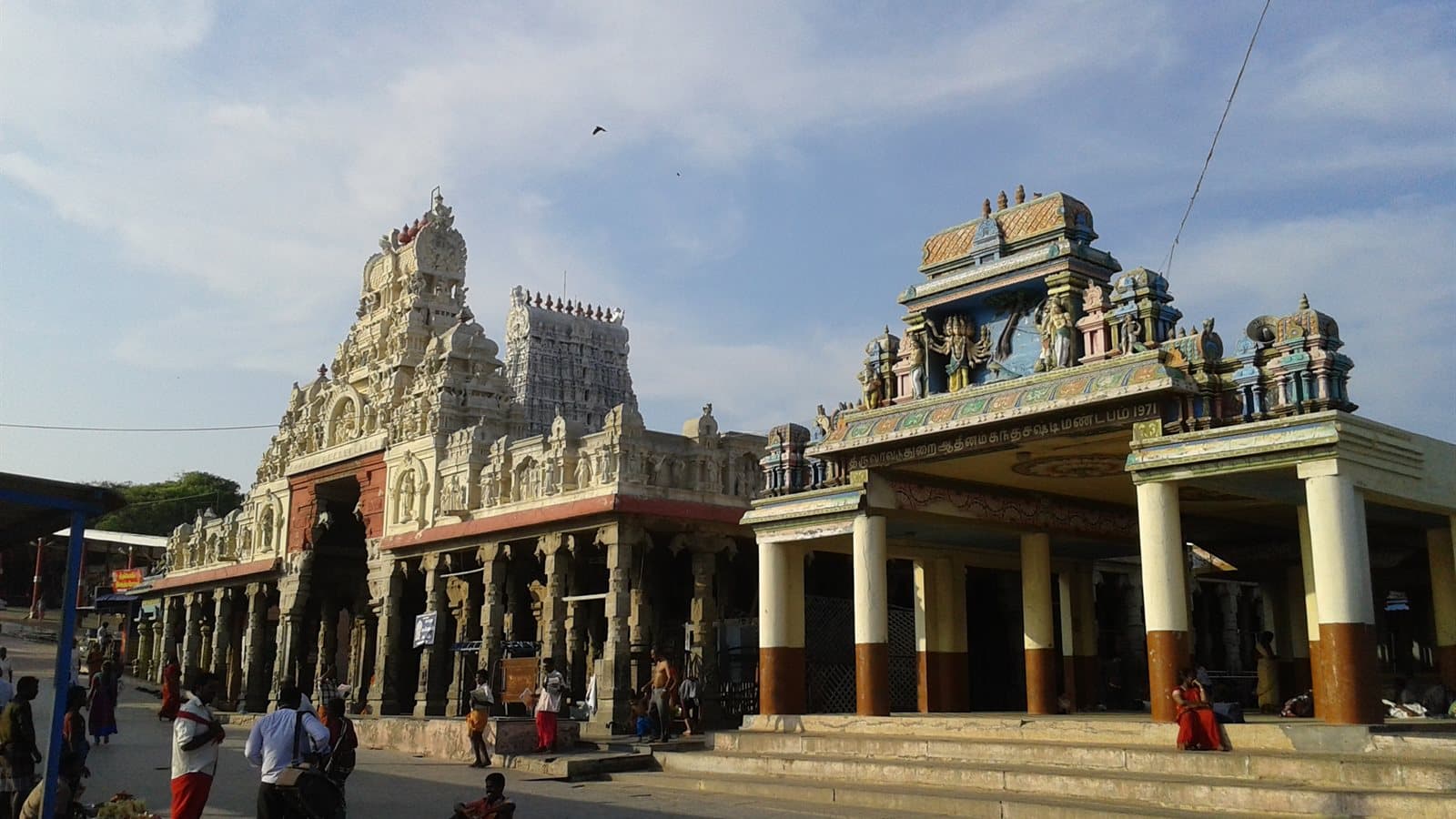
Tiruchendur Murugan
The only one of the six Arupadai Veedu located on the seashore. The majestic temple stands on a rocky promontory with the Bay of Bengal at its feet.
Official WebsiteHistory
The Arulmigu Subramaniya Swamy Temple at Tiruchendur is among the most revered Murugan shrines in the Tamil world, the second of the six Arupadai Veedu ('six battle camps' / abodes) and the only one by the sea. Its sanctity is sung in the Tamil Sangam-age and bhakti traditions (by the Nayanmars and in Nakkeerar's Tirumurugatruppadai) and it is here, according to the Skanda Purana, that Murugan marshalled the divine army and destroyed the asura Soorapadman. Portions of the sanctum are cut into the living rock of the shore. The temple's most dramatic historical episode came around 1648–1653, when Dutch East India Company forces seized its bronze processional idols; tradition holds that, guided by a vision and a floating lime that marked the spot, the devotee-administrator Vadamalaiyappa Pillai recovered the images from the sea and restored them. Successive Pandya, Nayaka and later patrons expanded the great gopuram, mandapams and corridors that crown the rocky promontory today.
Mythology & Legend
The Legend
When the asura Soorapadman, who had won great boons, tyrannised the devas and imprisoned them, the gods appealed to Shiva. From the spark of Shiva's third eye was born Murugan (Subrahmanya), the six-faced warrior-god, whom Shiva armed with the divine Vel (spear). Leading the celestial army southward, Murugan made his camp at Tiruchendur on the seashore. There, before joining battle, he first worshipped his father Shiva, installing and venerating a lingam, an act that makes Tiruchendur unique: the place where the warrior-god is himself the worshipper, and where he is enshrined in that devout, youthful form. Over six days the great battle raged, until on the sixth, Skanda Sashti, Murugan hurled the Vel and destroyed Soorapadman. In his final moment the repentant demon took the form of a tree that split in two; Murugan transformed the halves into his emblems: the peacock that became his mount (vahana) and the rooster that adorns his battle-flag.
The Nazhi Kinaru, Sweet Water in the Salt Sand
Among Tiruchendur's wonders is the Nazhi Kinaru, a small well sunk into the sandy shore only steps from the breaking waves of the Bay of Bengal. Though it lies amid salt sand by a salt sea, it yields sweet, drinkable water, a marvel attributed to the Lord's grace. By tradition the spot is linked to Murugan's army, which needed fresh water on the barren shore. Pilgrims draw and drink its water as theertham, and the well's persistence beside the sea is taken as a standing sign of the god's presence.
The Dutch Theft and the Recovery from the Sea
Around the mid-17th century, Dutch East India Company (VOC) forces operating on the Coromandel coast seized the temple's precious bronze processional idols, including the festival image of the Lord. Tradition recounts that the devotee and temple administrator Vadamalaiyappa Pillai was granted a vision revealing that the idols had been cast into or lost to the sea, and that a floating lime (or a hovering bird) would mark the exact spot. Following the sign, divers recovered the images from the waters and bore them back in triumph, and the festival worship was restored, an episode still recounted as proof of the Lord's refusal to abandon his shrine.
Why the Sea, and the Holy Bath
Alone among the six Arupadai Veedu, Tiruchendur sits at the ocean's edge rather than on a hill, and the Bay of Bengal itself serves as the temple's sacred theertham. Pilgrims traditionally bathe in the sea before ascending for darshan, washing away impurities in the very waters beside which Murugan won his victory. The sound of the surf against the rock beneath the sanctum is part of the temple's distinctive experience, binding the cosmic battle, the shore, and the act of worship into one.
Architecture
Tiruchendur is built on a low rocky promontory facing the Bay of Bengal, an unusual seaside setting for a major Dravidian temple. Its dominant landmark is the nine-storeyed western Mela Gopuram, rising about 157 feet over the flat coastal plain. The temple faces east toward the sea, but the towering gateway stands on the landward (west) side. Beyond it stretch pillared corridors and the Shanmukha Vilasa Mandapam leading to the sanctum, parts of which are hewn from the shore rock. The garbhagriha enshrines Senthil Andavar (Subrahmanya) flanked by shrines to his consorts Valli and Deivanai and to the boy-form Shanmukha. Close to the sea lies the marvel of the Nazhi Kinaru, a sweet-water well in the salt sand, and the shore itself serves as the temple theertham, where pilgrims bathe in the Bay of Bengal before climbing to the Lord.
Mela Gopuram (West Tower)
gopuramமேல கோபுரம்
The temple's commanding nine-tiered western gateway, rising about 157 feet over the flat coast and visible for miles. Though the temple faces east toward the sea, this great tower stands on the landward side and forms the principal entrance.
~157 ft · 9 tiers
Garbhagriha (Senthil Andavar)
sanctumThe inner sanctum, partly cut into the shore rock, enshrining Senthil Andavar (Subrahmanya) as a youthful Murugan in the rare devotional posture of one worshipping Shiva. The holiest point of the temple.
Rock-cut · Murugan as worshipper
Shanmukha Vilasa Mandapam
mandapamA pillared hall on the approach to the sanctum, named for the six-faced (Shanmukha) form of the Lord, carved with figures from the Murugan legends and leading the devotee inward through the temple.
Nazhi Kinaru (Sweet-Water Well)
tankநாழி கிணறு
The famous well of sweet water sunk into the salt sand of the seashore, only steps from the waves. Its fresh water amid the salt sea is revered as a miracle and taken by pilgrims as theertham.
Fresh water beside the salt sea
Bay of Bengal Theertham (Shore)
tankThe sea itself is the temple's sacred bathing place. Pilgrims take a holy dip in the Bay of Bengal at the foot of the promontory before climbing to the sanctum, a defining ritual of a Tiruchendur visit.
Corridors & Shore Mandapams
mandapamLong pillared corridors and mandapams crown the rocky promontory around the sanctum, several open toward the sea, giving the temple its unique character poised between rock and ocean.
Sub-shrines & Other Deities
Valli & Deivanai (Devasena)
The two consorts of MuruganValli, the hunter-chieftain's daughter who won the Lord by love, and Deivanai (Devasena), daughter of Indra wedded to him after the victory over Soorapadman, each honoured in their shrines beside the Lord.
Shanmukha / Jayanthinathar (Festival Deity)
The six-faced processional MuruganThe bronze utsava (processional) form of the Lord, among the idols famously recovered from the sea after the Dutch seizure, taken out on the temple car and through the streets during festivals.
Shiva Lingam (worshipped by Murugan)
Lord ShivaThe lingam linked to the legend of Murugan worshipping his father Shiva at Tiruchendur before the battle, the act that defines the temple's unique identity, where the warrior-god is also a devotee.
Vinayaka & the Murugan Forms
Lord Ganesha and the forms of MuruganVinayaka (Ganesha), invoked first to remove obstacles, alongside the various forms in which Murugan is venerated through the complex, as boy, warrior, and bridegroom.
Highlights
- 1The only one of the six Arupadai Veedu (sacred abodes of Murugan) situated on the seashore; all the others stand on hills
- 2The site where Lord Murugan worshipped Shiva and then slew the demon Soorapadman on the sixth day of Skanda Sashti (the Soorasamharam)
- 3The moolavar Senthil Andavar stands as a youthful Murugan in the rare posture of a devotee worshipping Shiva, the warrior-god as worshipper
- 4Set on a rocky promontory with the waves of the Bay of Bengal breaking at the temple's feet
- 5The Nazhi Kinaru: a well of sweet drinking water sunk into the seashore sand, yielding fresh water beside the salt sea
- 6A towering nine-tiered western Rajagopuram (~157 ft / 47 m) visible far across the flat coast
- 7Famous for the 17th-century recovery of its bronze festival idols from the sea after the Dutch (VOC) carried them off
Festivals & Events
Skanda Sashti (Soorasamharam)→
October–November (Aippasi)The temple's supreme festival: a six-day vratham re-enacting Murugan's war on Soorapadman, culminating on the sixth day in the spectacular Soorasamharam, the slaying of the demon, before lakhs of devotees on the shore, followed by the Thirukalyanam (the Lord's wedding to Devasena).
Vaikasi Visakam
May–June (Vaikasi)Celebrates Murugan's birth-star, Visakam, one of the holiest days for Murugan devotees, with grand abhishekams, processions and special worship of the six-faced Lord.
Masi Festival (Brahmotsavam)
February–March (Masi)A grand annual festival with the deities processed on the great temple car (ther) and a float festival, drawing crowds from across the south.
Aavani Festival
August–September (Aavani)Another major Brahmotsavam of processions and abhishekams, marking the temple's busy festival calendar through the Tamil year.
Sevas & Poojas
Sea Bath & Nazhi Kinaru Theertham
dailyThe traditional preparatory ritual of bathing in the Bay of Bengal and drinking the sweet water of the Nazhi Kinaru before darshan, purification in the very waters beside Murugan's battlefield.
Abhishekam to Senthil Andavar
specialThe sacred bathing of the Lord with milk, sandal, panchamrita and holy water amid Vedic and Tamil hymn recitation, sponsored by devotees on chosen days.
Archana (Kavacham)
dailyOffering of the devotee's name and birth-star with the recitation of the Lord's names; the Kanda Sashti Kavacham is especially favoured here, the great hymn of protection composed in Murugan's praise.
Kavadi Offering
specialDevotees carry the kavadi (an arched, decorated burden borne on the shoulders, often fulfilling a vow) to the Lord, especially during Vaikasi Visakam and Skanda Sashti, a hallmark of Murugan worship.
Soorasamharam & Thirukalyanam (Skanda Sashti)
specialWitnessing the climactic enactment of Murugan's victory over Soorapadman on the sixth day of Skanda Sashti, followed by the Lord's celestial wedding to Devasena, the most sought-after darshan of the year.
Fees and timings are indicative and may change. Please confirm with the temple office before travelling.