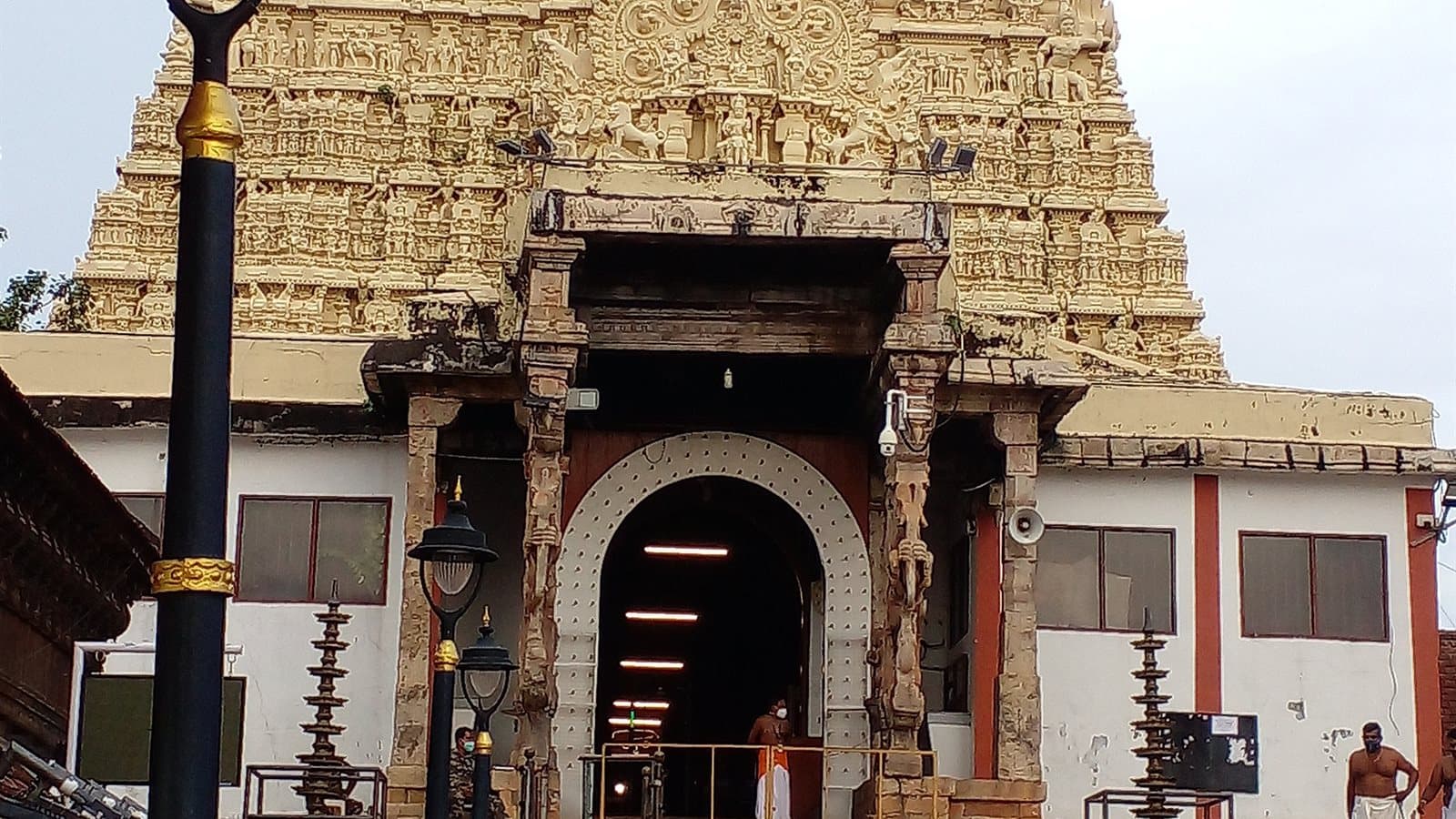
Padmanabhaswamy Temple
The wealthiest temple in the world, holding treasures estimated over ₹1 lakh crore. The reclining Vishnu idol carved from 12,008 Shaligram stones is a breathtaking sight.
Official WebsiteHistory
Sree Padmanabhaswamy Temple is among the oldest and most venerated Vishnu shrines in India, its sanctity sung by the Alvar saints Nammalvar and Kulasekara Alvar (8th–9th centuries), which makes it one of the 108 Divya Desams. The reclining deity gives the Kerala capital its name: Thiru-Anantha-Puram, 'the sacred city of Ananta'. While legends place its origins in deep antiquity, the temple acquired its present grandeur under the kings of Travancore. In 1750 CE, Anizham Thirunal Marthanda Varma performed the 'Thrippadi-danam', formally surrendering his entire kingdom to Lord Padmanabha and thereafter ruling, with all his successors, merely as the Lord's regent or 'Sree Padmanabha Dasa'. The royal family rebuilt and expanded the temple, commissioned the great gopuram and the long corridors, and entrenched a tradition of royal service that survives to this day. The temple returned to world attention in 2011, when, following litigation, the Supreme Court of India ordered an inventory of its sealed underground vaults (Kallaras), uncovering an astonishing hoard of gold, jewels, idols and ancient coins and confirming its reputation as the richest temple on earth.
Mythology & Legend
The Legend
The temple's origin legend centres on the sage Divakara Muni Vilvamangalam, a devotee of Vishnu. The Lord, wishing to test and reward him, appeared as a mischievous little boy who played about the sage's hermitage and disturbed his worship. One day the boy defiled the saligrama the sage was venerating, and the angry Vilvamangalam pushed him away. The child vanished, declaring that if the sage wished to see him again he must seek him in 'Ananthankadu', the forest of Ananta. Stricken with remorse, the sage wandered until, at Ananthankadu, he saw the boy merge into an enormous illupa (Indian butter) tree, which crashed down and took the form of Vishnu reclining on the serpent Anantha, stretching for miles. The sage begged the vast form to condense to a size he could worship; the Lord shrank to roughly eighteen feet, still so long that he must be seen through three doors. The spot became the sanctum, and the city around it took the deity's name.
The Three Doors and Anantha-Shayanam
Lord Padmanabha ('the lotus-naveled one') reclines in the Yoga-nidra posture on the thousand-hooded serpent Anantha (Adi Sesha), his right hand resting over a Shiva-linga, signalling the unity of Vishnu and Shiva. From his navel rises a lotus bearing four-faced Brahma, the creator. Because the image is so long, no single doorway can take it in; the devotee receives darshan through three separate doors, beholding in turn the face and chest, the navel with Brahma, and the sacred feet. The arrangement is itself a teaching: the worshipper must move and bow to see the whole, never grasping the infinite Lord in a single glance.
The Kingdom Given to God: Thrippadi-danam
In 1750, King Anizham Thirunal Marthanda Varma, founder of modern Travancore, performed the Thrippadi-danam, laying his sword and his entire conquered kingdom at the feet of Lord Padmanabha and declaring himself and all future kings to be merely 'Sree Padmanabha Dasa', the servant of Padmanabha. Thereafter the rulers governed not as sovereigns in their own right but as stewards acting in the Lord's name, depositing the realm's wealth as offerings to the deity. This vow explains both the immense treasures gathered in the temple vaults and the royal family's enduring, intimate role in its rituals.
The Saligrama Idol and Katu-Sarkara-Yogam
Unlike most temple idols of stone or metal, Padmanabha's image is built from 12,008 saligramas, the naturally fossil-marked sacred stones gathered from the bed of the Gandaki river in Nepal and, by tradition, carried south on elephant-back. These are bound and shaped with 'katu-sarkara-yogam', a hardened ayurvedic plaster of herbs, jaggery and other ingredients, over which the form is finished. Because of this fragile composition, no oil or water abhishekam is poured directly on the moolavar; worship is offered with special care, and the idol is periodically renewed by experts in the ancient technique.
Architecture
The temple is a striking synthesis of the indigenous Kerala style and the Tamil Dravidian tradition. Its most visible landmark is the 100-foot, seven-storeyed eastern Rajagopuram, raised in 1566, fronted by a temple tank (Padma Theertham, the 'lotus spring'). Beyond it stretch the Sheevelippura corridors lined with hundreds of carved granite pillars and a flagstaff (Dwajasthambham) plated in gold. Before the sanctum lies the Ottakkal Mandapam, a ceremonial hall hewn from a single immense slab of granite. Within the garbhagriha reclines the colossal Padmanabha on Anantha; because of his great length the deity is revealed through three doorways, the first showing the face and chest with Brahma rising on a lotus from the navel, the second the central body, and the third the feet. The underground Kallaras (treasure vaults), lettered A through F (with later additions), lie beneath the temple and store the accumulated offerings of centuries; the sealed Vault B remains famously unopened.
Eastern Rajagopuram
gopuramThe temple's defining silhouette: a seven-tiered eastern gateway tower rising about 100 feet, built in 1566 in the Pandya–Dravidian manner and ornamented with stucco figures from the Puranas. It overlooks the Padma Theertham tank and is among the most photographed landmarks of Thiruvananthapuram.
~100 ft · 7 tiers · built 1566
Garbhagriha (Anantha-Shayanam)
sanctumThe inner sanctum holding the great reclining form of Padmanabha on the serpent Anantha, fashioned from 12,008 saligramas. Owing to its length the deity is revealed through three doors. The right hand rests above a Shiva-linga and Brahma rises on a lotus from the navel, uniting the Trimurti in one image.
Reclining Vishnu · seen through 3 doors
Ottakkal Mandapam
mandapamA ceremonial pavilion in front of the sanctum carved from a single colossal slab of granite (its name means 'single-stone hall'). It is here that the king and chief devotees perform key rituals; entry onto it is restricted.
Hewn from one granite slab
Sheeveli Corridors & Gold Flagstaff
otherLong pillared corridors (the Sheevelippura) wrap the sanctum, lined with hundreds of intricately carved granite columns. The Dwajasthambham (flagstaff) before the sanctum is plated in gold, raised on a base of granite.
Gold-plated Dwajasthambham
Kallaras (Underground Vaults)
otherA series of sealed subterranean chambers, lettered A to F (with later-designated G–J), holding the offerings of centuries: gold ornaments, gem-set idols, ceremonial vessels, and antique coins. Vaults opened under court order in 2011 confirmed the temple as the richest on earth. Vault B remains unopened.
Vaults A–F · Vault B sealed
Padma Theertham
tankThe 'lotus spring', the temple's sacred tank lying just outside the eastern gopuram, where devotees traditionally bathe before darshan. Its still water mirrors the great tower.
Navaratri Mandapam
mandapamA finely sculpted hall used during the Navaratri festival, associated with the Travancore composer-king Swathi Thirunal and the annual Swathi Sangeetholsavam, a festival of Carnatic music held in the deity's presence.
Sub-shrines & Other Deities
Thekkedom (Narasimha)
Lord Narasimha (man-lion avatar of Vishnu)The fierce Narasimha shrine to the south of the main sanctum, one of the temple's principal sub-deities, sought by devotees for protection and the destruction of evil.
Ugra Narasimha & Krishna Swamy
Vishnu in his Narasimha and Krishna formsAdditional shrines within the complex venerating the Lord's avatars, with Krishna Swamy worshipped in his own sannidhi alongside the reclining Padmanabha.
Sastha (Ayyappa)
Lord Ayyappa / Dharma SasthaA shrine to Sastha within the temple, linking Padmanabhaswamy to the wider Kerala devotional landscape of which Sabarimala is the heart.
Ganapathy & Garuda
Lord Ganesha and the eagle-mount of VishnuGanapathy, invoked first to remove obstacles, and Garuda, the vahana of Vishnu, both honoured along the temple's prakaram for the devotee's preliminary prayers.
Highlights
- 1Widely regarded as the wealthiest place of worship in the world, after the 2011 inventory of its underground vaults revealed treasures valued in the tens of billions of dollars
- 2Lord Padmanabha reclines on the great serpent Anantha in the Anantha-Shayanam pose, viewable only through three separate doors
- 3The principal idol is fashioned from 12,008 saligrama stones brought from the Gandaki river in Nepal, bound with the herbal 'katu-sarkara-yogam' plaster
- 4One of the 108 Divya Desams ('Thiru-Anantha-Puram'); the city itself is named after the deity
- 5The Travancore royal family rules as 'Sree Padmanabha Dasa' (servant of Padmanabha) since Marthanda Varma dedicated the kingdom to the Lord in 1750
- 6A unique fusion of Kerala and Dravidian architecture, crowned by a 100-ft, seven-tier eastern gopuram (1566)
- 7The Ottakkal Mandapam, carved from a single massive granite slab, fronts the sanctum
Festivals & Events
Painkuni Utsavam
March–April (Meenam)A grand ten-day spring festival ending in the Aarattu (sacred immersion) procession, when the deities are carried to the Shankhumukham beach for a ritual sea-bath, escorted on foot by the Travancore Maharaja bearing a sword.
Alpasi Utsavam
October–November (Thulam)The autumn counterpart of Painkuni, another ten-day festival likewise concluding with the Aarattu procession to the sea at Shankhumukham.
Laksha Deepam
Once every six years (Jan)The temple's rarest and most dazzling event: the lighting of one lakh (100,000) oil lamps across the complex, held after 56 days of continuous Vedic recitation known as the Murajapam. The next occurrences fall in this six-year cycle.
Navaratri
September–OctoberThe nine-night festival of the Goddess, during which the Saraswati idol and the deities of the Navaratri Mandapam are worshipped, accompanied by the celebrated Swathi Sangeetholsavam classical music festival.
Sevas & Poojas
Sheeghra Darshanam
dailyThe quick-darshan privilege that lets the devotee bypass the general queue for a faster view of the Lord through the three doors, valuable on festival days and weekends.
Archana (Pushpanjali)
dailyOffering of flowers and recitation of the deity's names in the devotee's name and birth-star, performed by the temple priests.
Bhagavati Seva / Pushpanjali
specialSpecial floral and lamp worship sponsored by devotees for family welfare, prosperity and the removal of difficulties.
Niramala & Deeparadhana
dailyThe evening lamp ceremony (Deeparadhana) when the deity is worshipped amid rows of oil lamps, a serene daily highlight open to all worshippers.
Murajapam & Laksha Deepam
specialThe great six-yearly cycle of 56 days of continuous Vedic chanting (Murajapam) culminating in the lighting of one lakh lamps (Laksha Deepam) across the temple, the rarest seva-spectacle of the year.
Fees and timings are indicative and may change. Please confirm with the temple office before travelling.