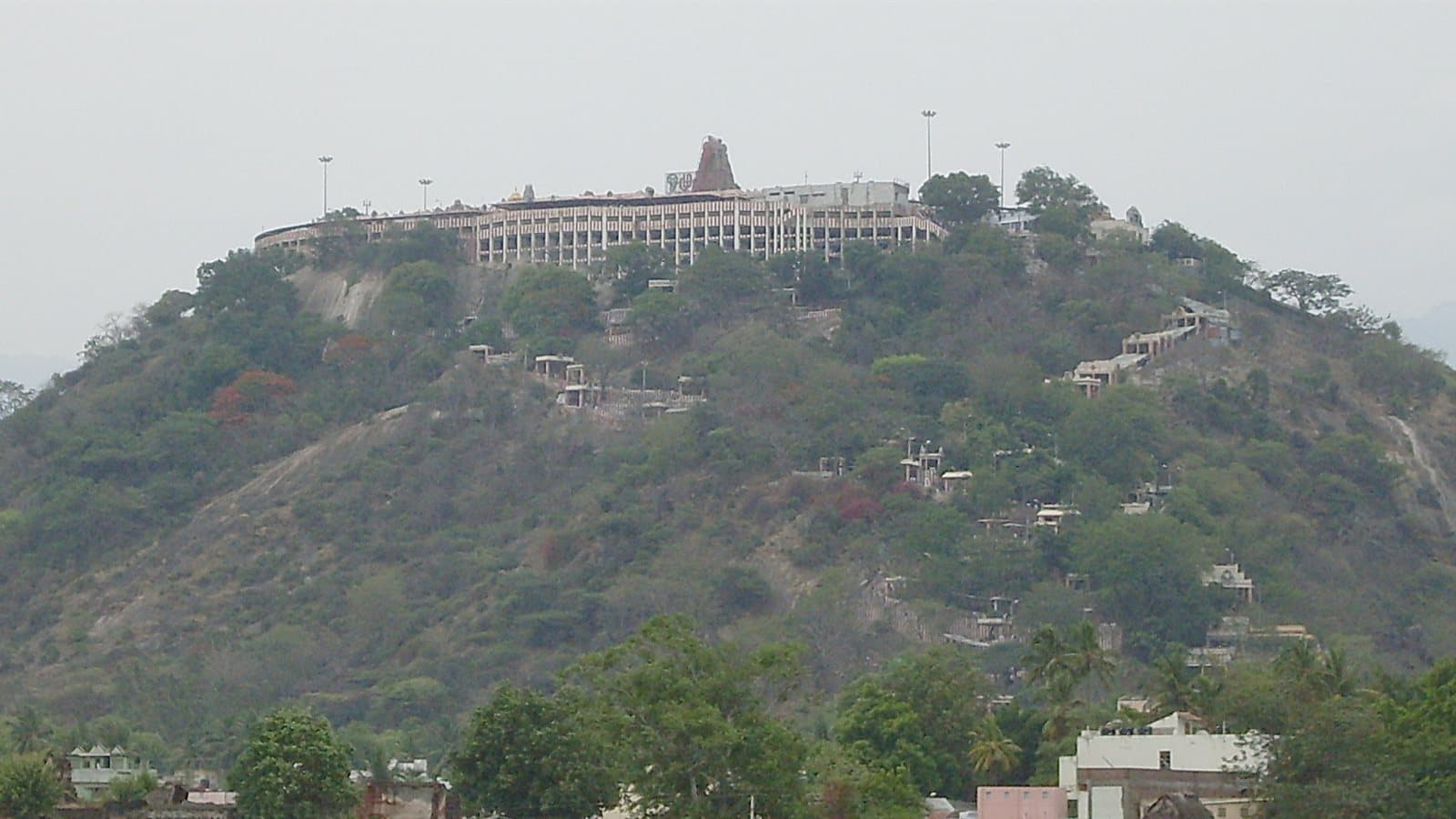
Palani Murugan
One of the six holy abodes of Murugan, perched on a hilltop. The idol is uniquely made of Navapashanam — a mixture of nine minerals with medicinal properties.
Official WebsiteHistory
The Arulmigu Dhandayuthapani Swamy Temple at Palani is one of the most visited and beloved of all Murugan shrines, the third of the six Arupadai Veedu, set atop the Sivagiri hill in Dindigul district. Its sanctity is rooted in the Tamil bhakti tradition and the Skanda legends, and it is bound up with the Siddha lineage of Tamil Nadu through the sage Bhogar, who, by tradition, sculpted the deity from nine medicinal substances (Navapashanam) and remains in samadhi within the temple. The town's name itself is held to come from the Lord's story: 'Pazham nee' ('you are the fruit'), the words spoken to console the renunciate Murugan, softened over time into 'Palani'. Across the centuries Pandya, Chera and later rulers and the Siddha tradition shaped the hill shrine, the foot temple of Thiru Avinankudi, and the great steps and gateways that pilgrims climb today. Palani is administered by the Tamil Nadu HR&CE and draws millions, above all at Thaipusam.
Mythology & Legend
The Legend
The defining legend of Palani is the contest for the fruit of wisdom. The sage Narada brought to Kailash a single divine mango (the Gnana Pazham, the fruit of supreme knowledge) which could not be cut or shared. Shiva and Parvati resolved to give it to whichever of their two sons first circled the world. Murugan at once mounted his peacock and sped off around the earth. But Ganesha, wise and unhurried, simply walked around his parents, declaring that they were his whole world, and so won the fruit. Returning to find himself outwitted and the fruit already given, Murugan felt slighted; renouncing his ornaments and even his clothing, he left Kailash and withdrew to the hill at Palani as a solitary ascetic, clad in a loincloth and holding only a staff (danda). There Shiva and Parvati came to console him, and Parvati (or, by another telling, the poet-saint Avvaiyar) soothed him with the words 'Pazham nee' ('you yourself are the fruit', the very essence of wisdom), from which the hill takes its name, Palani. The Lord remains there as Dhandayuthapani, 'he who bears the staff as his weapon', the god of renunciation.
Idumban and the Birth of the Kavadi
Idumban was an asura who became a devotee of the sage Agastya. Agastya wished to take two hills, Sivagiri and Sakthigiri, to the south, and asked Idumban to carry them. Idumban slung the two hills on either end of a pole across his shoulders (the first kavadi) and bore them south. Reaching Palani, he set them down to rest. When he tried to lift them again, they would not move: a small boy stood upon one hill, claiming it as his own. The two fought, and Idumban was slain, but the boy was Murugan himself, and at the pleading of Idumban's wife (and of the devotees) the Lord restored him to life. The grateful Idumban was made guardian of the hill, his shrine standing partway up. From his act comes the kavadi: every devotee who carries the decorated, arched burden up to Palani re-enacts Idumban's offering, and it is said the Lord grants the wishes of those who bring kavadi with devotion.
Bhogar and the Navapashanam Idol
By tradition the Palani idol was not carved from ordinary stone or metal but compounded by the Siddha sage Bhogar (Bhoganathar), one of the eighteen Siddhars, from Navapashanam, nine 'poisons', a secret amalgam of medicinal and mineral substances combined into a single hardened image of immense potency. Because of this, the milk, sandal, panchamrita and other substances poured over the idol in abhishekam absorb its virtue and are revered as curative prasadam. The composition is held to be impossible to replicate and so sacred that no ordinary abhishekam liquid is wasted. Bhogar is believed to have attained jeeva samadhi within the temple and to abide there still in yogic stillness; his shrine is venerated alongside the Lord.
The Panchamirtham of Palani
Palani is famous for its Panchamirtham, a sweet, fragrant prasadam made of five chief ingredients: the small Virupatchi hill bananas of the region, jaggery, ghee, honey and cardamom, with dates and sugar candy, pounded into a rich paste. Distributed to pilgrims as the Lord's blessing, it is so distinctive to the temple and its hill-grown bananas that it has been awarded a Geographical Indication (GI) tag. For countless devotees, receiving Palani Panchamirtham is inseparable from the pilgrimage itself.
Architecture
The temple crowns the Sivagiri hill, about 160 metres above the plain, reached by a long flight of stone steps (the Giri Veedhi) as well as a modern electric winch and a rope car. The hilltop sanctum enshrines Dhandayuthapani, Murugan as the staff-bearing ascetic, in the Navapashanam idol, facing east. Around it run the prakaram, mandapams and the golden-towered gateway, with the Bhogar Sannidhi (the Siddha's samadhi shrine) set within the complex and connected by tradition to an underground passage. Partway up the hill stands the shrine of Idumban, the guardian, and at the very foot of the hill lies the Thiru Avinankudi temple, where Murugan is worshipped with his consorts and peacock, together the 'Adivaram' (base) and hilltop shrines form the sacred whole of Palani. The two hills, Sivagiri and Sakthigiri, are themselves part of the legend of Idumban's burden.
Hilltop Sanctum (Dhandayuthapani)
sanctumThe east-facing inner sanctum atop the Sivagiri hill enshrining the Navapashanam idol of Murugan as Dhandayuthapani, the staff-bearing renunciate. The holiest point of the temple, where the medicinal abhishekam is performed.
Navapashanam idol · Murugan as ascetic
Bhogar Sannidhi (Samadhi Shrine)
otherThe shrine of the Siddha sage Bhogar, who by tradition created the idol and attained jeeva samadhi within the temple. Connected by legend to an underground passage, it is venerated by devotees as the abode of the living Siddha.
Giri Veedhi Steps, Winch & Rope Car
otherThe hill is ascended by an ancient flight of stone steps (the Giri Veedhi), by an electric winch (a rope train running up the slope), and by a rope car (cable car), the three ways pilgrims reach the summit, the steps climbed barefoot by the most devout.
Steps · winch · cable car
Idumban Shrine
otherThe shrine of Idumban, the asura-turned-devotee made guardian of the hill, set partway up the ascent. Kavadi-bearers pause to worship here, honouring the origin of the kavadi tradition.
Thiru Avinankudi (Adivaram Temple)
otherThe temple at the very foot of the hill, where Murugan is worshipped with his consorts Valli and Deivanai and his peacock. Together with the hilltop shrine it forms the complete sacred whole of Palani.
Sivagiri & Sakthigiri Hills
otherThe two hills of Palani, by legend the very hills Idumban carried on his kavadi. The Dhandayuthapani temple crowns Sivagiri; the paired hills are part of the landscape sanctity of the shrine.
Sub-shrines & Other Deities
Bhogar (Siddhar)
The Siddha sage BhoganatharOne of the eighteen Siddhars, creator of the Navapashanam idol, enshrined in jeeva samadhi within the temple and worshipped as a living presence who still guards and blesses the shrine.
Idumban
The asura-devotee, guardian of the hillSlain and restored by Murugan, made the hill's guardian; his shrine partway up the ascent is the spiritual root of the kavadi offering that defines Palani pilgrimage.
Valli & Deivanai (at Thiru Avinankudi)
The two consorts of MuruganBecause Dhandayuthapani on the hill is the solitary renunciate, the Lord is worshipped with his consorts Valli and Deivanai at the foot-of-hill temple of Thiru Avinankudi.
Vinayaka
Lord GaneshaMurugan's brother and the very figure who won the fruit of wisdom in the central legend, worshipped first by devotees to remove obstacles before the climb and darshan.
Highlights
- 1One of the six Arupadai Veedu (sacred abodes of Murugan), crowning the Sivagiri hill above the town of Palani
- 2Lord Dhandayuthapani is worshipped as a young renunciate, head shaven, clad only in a loincloth, holding a danda (staff), the god who renounced all after the contest for the fruit of wisdom
- 3The idol is made of Navapashanam, an amalgam of nine medicinal minerals fashioned by the Siddha sage Bhogar; uniquely, the abhishekam runoff becomes curative prasadam
- 4Home of the famous Palani Panchamirtham, a GI-tagged five-ingredient sweet prasadam
- 5The birthplace of the kavadi tradition, born of the legend of Idumban carrying the two hills
- 6Bhogar, one of the eighteen Siddhars, is enshrined here in jeeva samadhi, having created the idol and remained in yogic repose
- 7Reached up the hill by ancient stone steps, an electric winch (rope train), or a rope car (cable car)
Festivals & Events
Thaipusam
January–February (Thai)Palani's greatest festival and the largest kavadi pilgrimage in the Tamil world. Lakhs of devotees walk to the hill, many on foot from distant towns, bearing kavadis and milk-pots (paal kudam) as vows, recalling the gift of the Vel to Murugan. The hill and town overflow day and night.
Panguni Uthiram
March–April (Panguni)A grand festival marked by the temple car (ther) procession and the celestial associations of Murugan, drawing vast crowds and kavadi-bearers up the hill.
Vaikasi Visakam
May–June (Vaikasi)Celebrates Murugan's birth-star, Visakam, with special abhishekams and processions, among the holiest days for his devotees.
Skanda Sashti→
October–November (Aippasi)The six-day festival of Murugan's victory over Soorapadman, observed with fasting, processions and devotion at Palani as at the other Arupadai Veedu.
Sevas & Poojas
Abhishekam (Navapashanam)
specialThe sacred bathing of the Navapashanam idol with milk, panchamrita, sandal and holy water; because of the idol's medicinal composition the runoff is revered as curative prasadam, sought by devotees for healing.
Panchamirtham Prasadam
dailyReceiving the temple's famous GI-tagged Panchamirtham (the sweet paste of hill bananas, jaggery, ghee, honey and cardamom) as the Lord's blessing, inseparable from a Palani pilgrimage.
Kavadi Offering
specialCarrying the kavadi (the arched, decorated shoulder-burden) up the hill in fulfilment of a vow, re-enacting Idumban's offering. The defining act of devotion at Palani, at its height during Thaipusam.
Paal Kudam (Milk-Pot Offering)
specialBearing pots of milk up to the hilltop to be poured over the Lord in abhishekam, a popular and accessible vow carried by pilgrims of all ages, especially during Thaipusam.
Mottai (Tonsure / Hair Offering)
specialThe offering of one's hair by tonsuring the head as an act of surrender and the fulfilment of a vow. Palani is one of the major temples where devotees, including children, offer their hair.
Rakkala Santhanam (Night Sandal)
dailySandal paste applied to the idol at the night Rakkala pooja and removed at dawn, by then imbued with the idol's medicinal virtue and distributed to devotees as a prized healing prasadam.
Fees and timings are indicative and may change. Please confirm with the temple office before travelling.