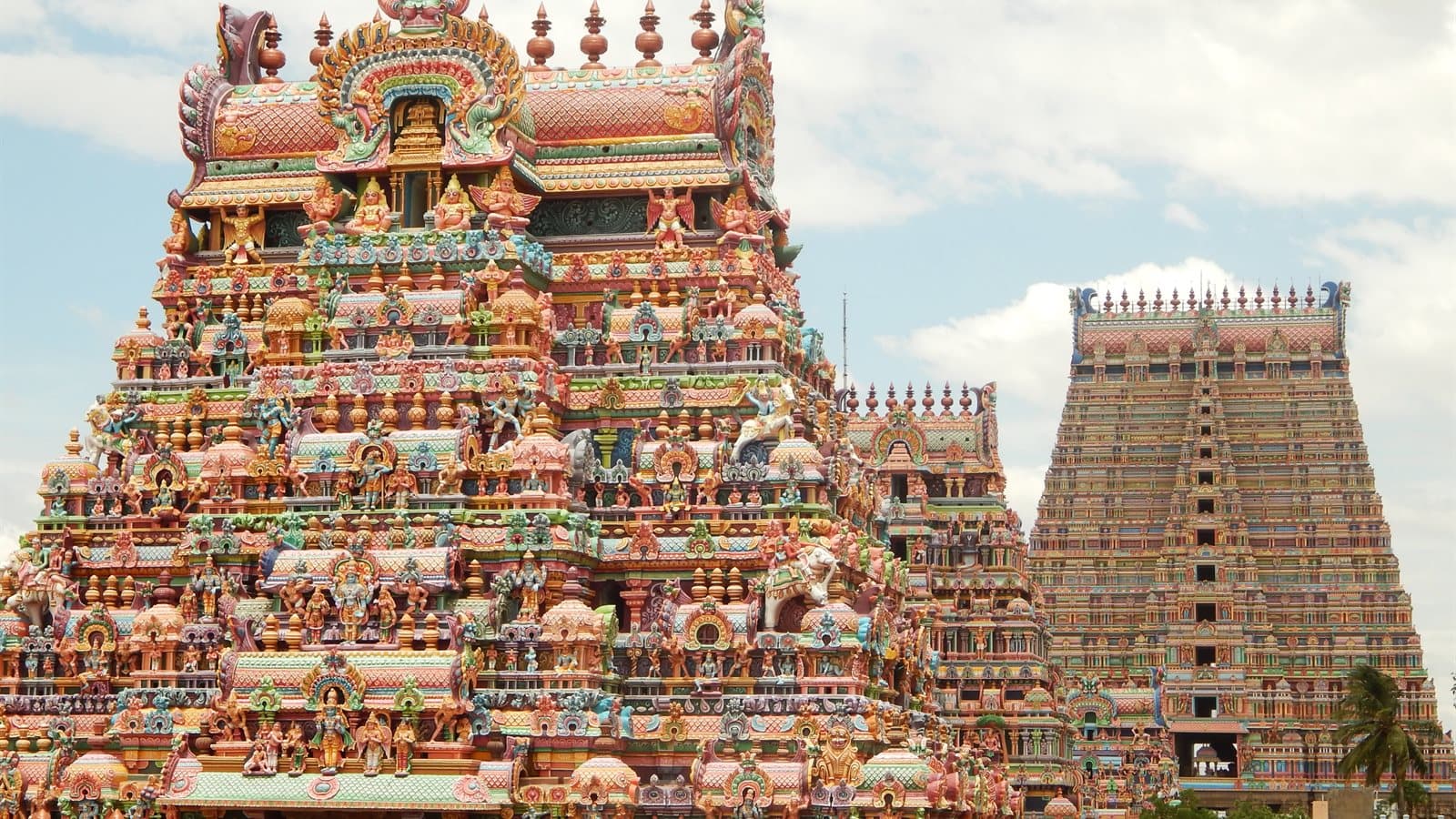
Ranganathaswamy Temple
The largest functioning Hindu temple complex in the world, spread over 156 acres with 21 gopurams. A premier Vaishnava shrine and the first of the 108 Divya Desams.
Official WebsiteHistory
Sri Ranganathaswamy is the greatest of the Vaishnava temples and the largest functioning temple complex on earth, spread across 156 acres on an island in the Cauvery near Tiruchirapalli. Its sanctity is recorded in the Sangam-era Tamil classic Silappathikaram and glorified by all twelve Alvar poet-saints (7th–9th centuries). Successive dynasties (Cholas, Pandyas, Hoysalas, the Vijayanagara emperors, the Nayaks of Madurai and the Marathas) each added prakarams, gopurams and mandapams over a thousand years, producing the vast concentric town-temple seen today. The 11th–12th century philosopher Sri Ramanuja made Srirangam the headquarters of Sri Vaishnavism and reorganised its worship; his enshrined body remains a focus of pilgrimage. The temple endured the trauma of the 1311 CE invasion by Malik Kafur, when the festival deity was carried into hiding for some sixty years and thousands of devotees died defending the shrine. The towering Rajagopuram, begun in the Vijayanagara era and left unfinished for centuries, was finally completed only in 1987.
Mythology & Legend
The Legend
The Sri Ranga Vimana, the shrine of the reclining Vishnu, is said to be self-manifest, first worshipped by Brahma himself, who passed it to the Sun dynasty (Ikshvaku) of Ayodhya. There it was venerated by generations of kings, including Lord Rama. After Rama's coronation, in gratitude for his devotion, he gifted the vimana and its deity to Vibhishana, the righteous brother of Ravana, to carry home and worship in Lanka. As Vibhishana journeyed south he rested on the island of Srirangam in the Cauvery and set the vimana down on the riverbank. When he tried to lift it again, it would not move: the Lord had chosen this island, between the two arms of the sacred river, as his eternal resting place. Ranganatha consented to remain at Srirangam but, to honour Vibhishana's devotion, turned to recline facing south, toward Lanka, so that he might bless his devotee forever. To this day the Lord lies gazing south, and Vibhishana is believed to come each night to worship.
The Divine Wedding
Sri Ranganatha's consort is Sri Ranganayaki, called Thayar ('Divine Mother'). Uniquely, the two share a joint darshan (Serthi) only once a year, at Panguni Uttiram, for Thayar, as the supreme mediatrix between the soul and the Lord, keeps to her own shrine the rest of the year. The temple also celebrates the Thirukalyanam of Andal, the girl-saint of Srivilliputhur who vowed to marry none but Ranganatha and, by tradition, merged into him at Srirangam itself.
Thiruppaan Alvar and the Lord's Command
Thiruppaan Alvar, a saint of humble birth, would stand on the far bank of the Cauvery singing to Ranganatha, never daring to enter the temple. One morning the temple priest Lokasaranga Muni, going to fetch water, ordered the saint out of the path and, when he did not stir from his trance, struck him with a stone. That night the Lord appeared to the priest in a dream and commanded him to carry Thiruppaan Alvar into the sanctum on his own shoulders. Borne to the very sanctum, the saint poured out the ten verses of the Amalanadipiran in praise of the Lord from foot to crown, and, completing them, merged into the deity before the eyes of all. The episode gave the saint his name 'Munivahana' (carried on the sage's shoulders) and remains the temple's parable of devotion above birth.
Sri Ramanuja, the Master of Srirangam
The 11th–12th century acharya Sri Ramanuja (traditionally 1017–1137) made Srirangam the world centre of Sri Vaishnavism and of his Vishishtadvaita philosophy. He systematised the temple's daily worship, its festival calendar and its administration, dividing duties among the temple servitors in arrangements still partly followed. By tradition his body was preserved after death and enshrined within the temple, seated as in life; the Ramanuja sannidhi, with its 'Thaan Ana Thirumeni' ('the body that is himself'), is venerated by every pilgrim. His Sri Bhashya commentary, taught here, shaped the devotional theology of South India.
Thulukka Nachiyar and the Lord's Journey to Delhi
When Malik Kafur's army sacked Srirangam in 1311, the festival deity Azhagiya Manavalan was spirited away and, by one account, ended up in the Delhi Sultanate's court, where the Sultan's daughter grew devoted to the beautiful image and kept it with her. Srivaishnava devotees journeyed north to recover it; the princess, by the legend, followed the Lord south and, unable to be parted, attained him at Srirangam. She is enshrined as Thulukka Nachiyar (Bibi Nachiyar), and to this day the Lord is offered chapati and butter and is dressed in a manner honouring her, a striking testament to the temple's memory of that turbulent age.
The Defence of the Lord and the Hidden Sanctum
During the invasions, the Srivaishnava acharyas walled up the inner sanctum to conceal the immovable Moolavar (root deity) and led the festival deity to safety across the Deccan, even to Tirupati. Tradition holds that thousands of devotees laid down their lives defending the shrine, and that the deity was away for some sixty years before being ceremonially restored. The episode is remembered each year, and the temple's later fortifications and the long-unfinished Rajagopuram are read by devotees as scars and renewals of that history.
Architecture
Srirangam is built as seven rectangular concentric enclosures (prakarams) around the sanctum, the outermost forming a living temple-town of streets, homes and shops, the inner four reserved for worship. Twenty-one gopurams punctuate the walls, crowned by the 73-metre Rajagopuram on the south, the tallest temple tower in Asia. Over the sanctum rises the gold-plated Sri Ranga Vimana, uniquely shaped like the Pranava ('Om'), sheltering the reclining Ranganatha on Adisesha. The complex is a museum of South Indian sculpture across dynasties: the Sesharaya Mandapam with its rearing-horse (yali) war-horse pillars, the Garuda Mandapam, the Venugopala shrine's exquisite maidens, and the 'Aayiram Kaal' thousand-pillared hall (actually 953 granite pillars). The temple's conservation won a UNESCO award in 2017.
Rajagopuram
gopuramராஜகோபுரம்
The southern gateway tower, at about 73 metres (236 ft) and 13 tiers, the tallest temple gopuram in Asia. Its base was laid in the Vijayanagara period but the tower stood as an unfinished stump for over four centuries; it was completed in white-and-gold stucco only in 1987 under the 44th Jeeyar of the Ahobila Mutt. It is visible for miles across the Cauvery plain.
~73 m · 13 tiers · completed 1987
Sri Ranga Vimana (Pranavakara Vimana)
vimanaஸ்ரீ ரங்க விமானம்
The gold-plated tower directly over the sanctum, shaped like the sacred syllable 'Om' (Pranava), hence Pranavakara Vimana. Considered self-manifest and beyond ordinary construction, it shelters the reclining Ranganatha and is the holiest point of the entire complex.
Gold-plated · shaped like 'Om'
Garbhagriha, Ranganatha on Adisesha
sanctumThe inner sanctum houses the colossal reclining form of Lord Ranganatha stretched upon the coils of the serpent Adisesha, his head to the west and feet to the east, face turned south toward Lanka. The Moolavar (immovable deity) here is the heart of the temple; the festival image, Azhagiya Manavalan, processes outside on his behalf.
Reclining Vishnu, facing south
Seven Prakarams
otherSeven concentric rectangular enclosures wrap the sanctum, named (from outermost inward) Chitra, Thiruvikrama, Akalanka, Alinadan, Kulasekaran, Rajamahendran and Dharmavarman. The outer enclosures form a populated temple-town of streets and houses; only past the fourth wall does worship space begin. The total outer perimeter runs about 4 km.
7 enclosures · ~4 km outer perimeter
Sesharaya Mandapam
mandapamA Vijayanagara-era hall on the fourth prakaram famous for its monolithic war-horse pillars, rearing yalis and cavalrymen carved leaping from single granite blocks, among the masterpieces of 16th-century Nayaka sculpture.
Aayiram Kaal Mandapam (Thousand-Pillar Hall)
mandapamஆயிரம் கால் மண்டபம்
The great hall of (nominally) a thousand pillars, in fact 953 granite columns arranged in ordered rows, built in the Chola–Vijayanagara periods. It is the setting for the climactic rituals of the Adhyayana Utsavam during Vaikunta Ekadasi.
953 pillars
Venugopala Shrine
otherA shrine in the south-western part of the complex celebrated for the sensuous perfection of its carvings, gopis and dancers around Krishna playing the flute, rated among the finest figural sculpture in any Tamil temple.
Paramapada Vasal (Gateway to Heaven)
otherThe 'Sorga Vasal', a normally-sealed doorway opened only for the ten days around Vaikunta Ekadasi, through which devotees pass behind the festival deity in the belief that it grants liberation (moksha). The single most sought-after passage in the Srivaishnava year.
Sub-shrines & Other Deities
Sri Ranganayaki Thayar
Goddess Lakshmi, consort of RanganathaThe Divine Mother in her own large shrine within the complex, so central that the temple is as much hers as the Lord's. She gives joint darshan with Ranganatha only on Panguni Uttiram; the rest of the year devotees approach her separately as the compassionate mediatrix who carries the soul's plea to the Lord.
Udayavar (Sri Ramanuja)
The Acharya Sri RamanujaThe shrine enshrining the preserved body of Sri Ramanuja, seated as in life. Revered as 'Thaan Ana Thirumeni', the form that is the master himself, and venerated by every pilgrim as the founder of the temple's living tradition.
Chakkarathazhwar (Sudarshana)
The Discus of VishnuThe fierce form of the Lord's Sudarshana chakra, worshipped on the reverse face with Narasimha. A powerful shrine sought for protection and the removal of evil.
Thiruppaan Alvar & the Alvars
The twelve Alvar poet-saintsSrirangam, praised by all twelve Alvars, honours them with shrines, most movingly Thiruppaan Alvar, the humble singer who merged into the deity. Their Nalayira Divya Prabandham is recited here daily.
Thulukka Nachiyar (Bibi Nachiyar)
The Sultan's daughter devoted to the LordThe shrine remembering the princess who loved the festival deity during its sojourn in the north. The Lord is offered chapati and butter in her honour, a unique custom born of the temple's medieval history.
Dhanvantari
The Divine PhysicianA rare shrine to Dhanvantari, the physician of the gods; the theertham (sacred water) given here is taken by devotees as medicine for health and healing.
Andal & Garuda
Andal and the eagle-mount of VishnuAndal, the girl-saint who wished only for Ranganatha, and Garuda, the Lord's vahana before whom devotees first offer prayers, both with shrines along the prakarams.
Highlights
- 1The largest functioning Hindu temple complex in the world: 156 acres, seven concentric prakarams, 21 gopurams
- 2The Rajagopuram is the tallest temple tower in Asia at ~73 m (236 ft), 13 tiers, completed in 1987
- 3The foremost of the 108 Divya Desams, 'Bhoolokha Vaikuntham', heaven on earth; the only Divya Desam praised by all 12 Alvars
- 4Lord Ranganatha reclines on the serpent Adisesha, facing south toward Lanka to bless Vibhishana
- 5The gold-plated Sri Ranga Vimana over the sanctum is shaped like the sacred 'Om' (Pranavakara)
- 6The spiritual home of Sri Ramanuja, whose preserved body (Thirumeni) is enshrined here
- 7UNESCO Asia-Pacific Award of Merit (2017) for heritage conservation
Festivals & Events
Vaikunta Ekadasi & Adhyayana Utsavam→
December–January (Margazhi)The grandest festival, a 21-day Pagal Pathu and Ra Pathu celebration centred on the opening of the Paramapada Vasal ('Gateway to Heaven'). The deity is brought to the thousand-pillared hall and the entire Nalayira Divya Prabandham is recited, including the unique Araiyar Sevai. Lakhs pass through the Heaven's Gate.
Chithirai Brahmotsavam
April–MayThe annual ten-day Brahmotsavam with the Lord processed daily on different vahanas through the prakarams, culminating in the grand car (ther) festival.
Panguni Uttiram (Serthi Utsavam)
March–AprilThe one day of the year Ranganatha and Sri Ranganayaki Thayar give joint darshan (Serthi) on the same dais, a rare and deeply cherished sight, as Thayar otherwise stays in her own shrine.
Jyeshtabhishekam
June–July (Aani)A three-day summer ritual in which the deity's golden armour and ornaments are removed and a grand abhishekam performed to cool and cleanse the Lord.
Andal Thirukalyanam
July–August (Aadi Pooram)The celestial wedding of Andal, the Alvar-saint who longed only for Ranganatha, celebrated with great devotion.
Sevas & Poojas
Viswaroopa Seva
dailyThe first darshan of the day, when the sanctum opens to reveal the reclining Lord in his full 'cosmic' form (Viswaroopam) before the day's adornment, considered an especially blessed sight.
Thirumanjanam (Abhishekam)
specialThe sacred bathing of the deity with milk, curds, honey, sandal and holy water amid Vedic and Prabandham recitation. Sponsored on chosen days.
Sahasranama Archana
dailyRecitation of the Vishnu Sahasranama (the 1,000 names) in the devotee's name and star, with offering of tulsi.
Unjal (Swing) Seva
weeklyThe festival deities are seated on a decorated swing and gently rocked to the singing of Prabandham hymns, performed on Fridays and festival occasions.
Araiyar Sevai
specialA rare hereditary art surviving chiefly at Srirangam: the Araiyars sing and enact the Nalayira Divya Prabandham with hand-gestures and cymbals before the deity, above all during the Adhyayana Utsavam of Margazhi.
Ekantha Seva (Night Rest)
dailyThe final ritual of the day, when the Lord is put to rest with lullabies; devotees may witness the close of the temple's daily cycle.
Fees and timings are indicative and may change. Please confirm with the temple office before travelling.