History
The Thanumalayan temple at Suchindram, in the Kanyakumari district at the southern tip of the mainland, is one of the great temples of the deep south, set in territory that long belonged to the kingdom of Travancore. Its origins are ancient, woven into the sthala purana of the place, but the temple as it stands was raised and enlarged over many centuries by the Pandya, Chola and Vijayanagara rulers and, in its present grand form, largely by the Nayak and Travancore kings around the seventeenth century, who built the towering gopuram, the great mandapams and the famous sculptures. The presiding deity is Sthanumalayan, the union of the three gods of the Trinity in a single linga, a rare theological conception that gives the temple its character as a shrine to all three. The town's name, Suchindram, is traced to the purification of Indra here, and the temple has long been a place where the Lord is worshipped as Brahma, Vishnu and Shiva together. It is administered today by the Travancore Devaswom Board.
Mythology & Legend
The Legend
The presiding deity Sthanumalayan is the three great gods of the Trinity joined in one, and the temple's sthala purana tells how this came to be through the chastity of Anasuya, wife of the sage Atri. So renowned was Anasuya for her virtue that Brahma, Vishnu and Shiva resolved to test her, and came to her hermitage as guests while her husband was away, asking to be served their meal as she was, unclothed. Seeing through the test and unwilling either to refuse a guest or to break her vow, Anasuya sprinkled water from her husband's worship upon the three and turned them into infants, then served them as a mother serves her children. When their consorts came in search of them and begged for their lords, Anasuya restored them, and in grace the three gods merged into a single linga at this place, worshipped ever since as Sthanumalaya, Sthanu the Shiva, Maal the Vishnu and Ayan the Brahma in one form.
Suchindram and the Purification of Indra
The town's name, Suchindram, is traced to the purification of Indra, the king of the gods. By the well-known story, Indra was cursed by the sage Gautama for his transgression with Ahalya, the sage's wife, and wandered stained by the curse until he came to this place and worshipped the Lord here. By that worship he was cleansed and made pure, suchi, and so the place became Suchi-Indram, the place where Indra was purified. It is believed that Indra still descends to worship the Lord at midnight each day, and the temple keeps a lamp and observance in his honour, the night worship associated with the king of the gods.
The Musical Pillars and the Monolithic Hanuman
Suchindram is celebrated for two wonders of stone. The first is its musical pillars: clusters of slender columns, each carved from a single block of granite, that ring with distinct musical notes when gently struck, a feat of the sculptor's craft that has drawn wonder for centuries. The second is the colossal image of Hanuman, some eighteen feet tall, carved from a single block of stone, one of the largest such monolithic figures in any temple. Together with the towering white gopuram and the sculpture-crowded mandapams, they make Suchindram one of the marvels of southern temple art.
A Temple of the Three Gods
Few temples in India are dedicated to all three gods of the Trinity worshipped as one, and Suchindram is the foremost among them. The single linga of Sthanumalaya is venerated at once as Shiva the destroyer, Vishnu the preserver and Brahma the creator, so that devotees of all three traditions worship here as one. This union, born of the legend of Anasuya, gives the temple its rare standing as a shrine where the divisions among the deities dissolve into a single object of worship, a fitting emblem for a place at the very southern meeting-point of the land.
Architecture
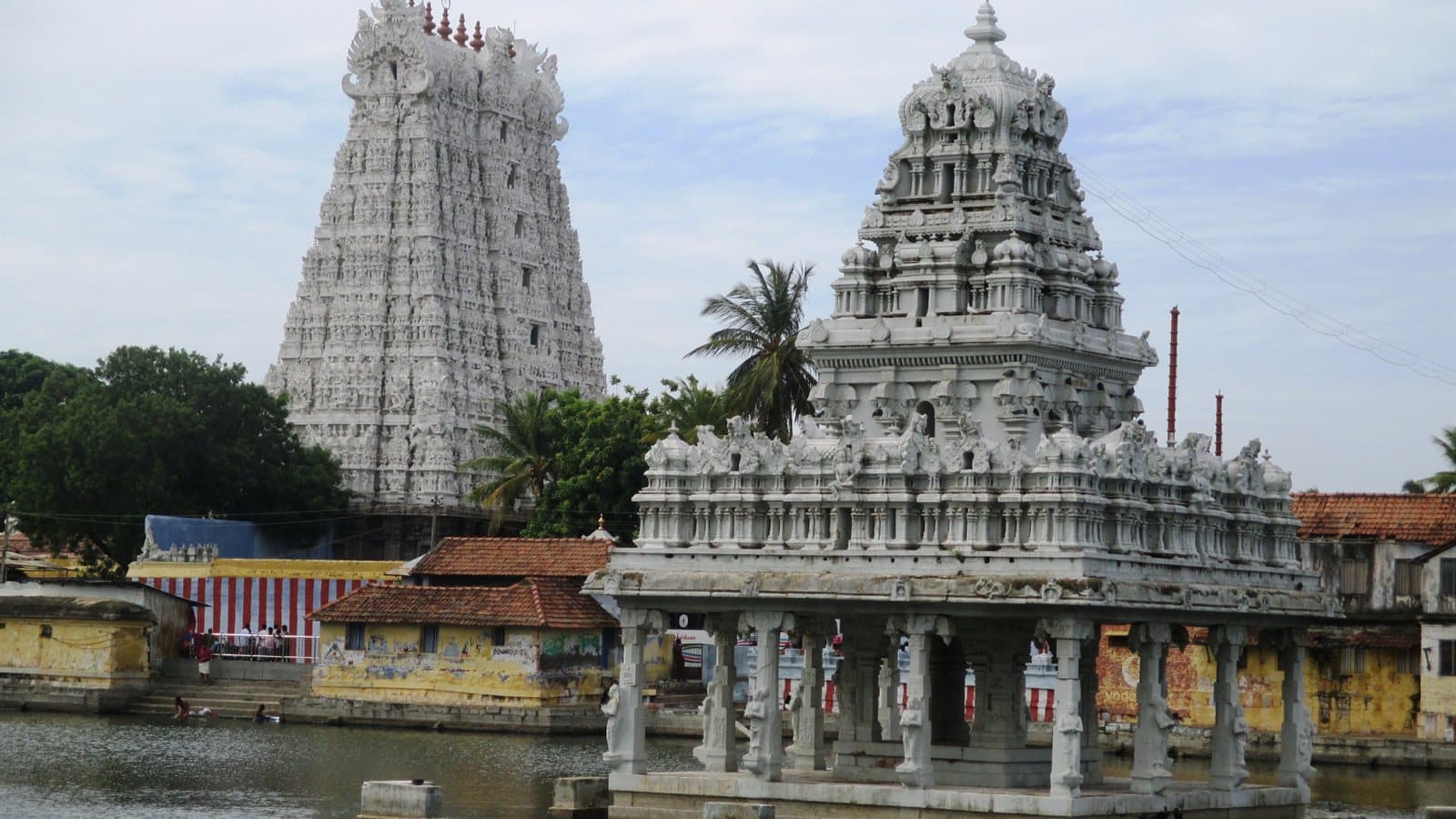
Suchindram is a vast Dravidian temple, entered beneath a white seven-tiered gopuram rising about 134 feet, one of the landmarks of the far south. Within, the sanctum enshrines the Sthanumalaya linga, worshipped as Brahma, Vishnu and Shiva in one. The temple is famed above all for its stonework: the musical pillars, clusters of slender columns each carved from a single block of granite, sound musical notes when tapped, a marvel of the sculptor's art; and a giant monolithic image of Hanuman, some eighteen feet tall, carved from one block of stone. The Alankara Mandapam and the other halls are crowded with sculpture of gods, yalis and figures from the epics, and the temple holds a Nataraja shrine, shrines to the Goddess Aram Valartha Nayaki and to Hanuman, and a sacred tank. The whole complex, with its long corridors and pillared halls, reflects the wealth and artistry of the Nayak and Travancore patrons who shaped it.
Eastern Gopuram
gopuramThe towering white seven-tiered gateway, rising about 134 feet over the temple and the town, one of the great landmarks of the far south, built under the Nayak and Travancore patrons.
~134 ft · seven tiers
Garbhagriha (Sthanumalaya Linga)
sanctumThe sanctum enshrining the linga worshipped as Brahma, Vishnu and Shiva in one, the rare combined deity Sthanumalayan from whom the temple takes its name.
Trinity worshipped as one linga
Musical Pillars
mandapamClusters of slender columns, each carved from a single block of granite, that sound distinct musical notes when struck, among the most famous works of stone craft in any South Indian temple.
Granite pillars that ring with notes
Monolithic Hanuman
otherA giant image of Hanuman, some eighteen feet tall, carved from a single block of stone, one of the largest monolithic figures of the deity in any temple.
~18 ft single-stone Hanuman
Alankara Mandapam
mandapamThe richly sculptured hall crowded with figures of gods, yalis and scenes from the epics, displaying the artistry of the temple's Nayak and Travancore builders.
Nataraja Shrine
otherThe shrine of the dancing Shiva (Nataraja) within the complex, worshipped alongside the combined deity, reflecting the temple's Shaiva dimension.
Temple Tank
tankThe sacred tank of the temple, used for the float festival and for ritual bathing, set within the temple's wide precinct.
Sub-shrines & Other Deities
Aram Valartha Nayaki
The Goddess, consort of the LordThe Goddess of the temple, 'she who nurtured dharma', worshipped with her own shrine and the focus of the Navaratri festival.
Hanuman (Anjaneya)
Lord HanumanHanuman worshipped in the giant monolithic image, one of the most striking deities of the temple, venerated for strength and protection.
Vinayaka (Ganesha)
Lord GaneshaGanesha worshipped within the precinct for the removal of obstacles, honoured before the main darshan as is the custom.
Nataraja
Shiva as the Lord of the DanceThe dancing Shiva venerated in his shrine within the complex, part of the temple's worship of Shiva as one of the Trinity.
Highlights
- 1A rare temple where the Hindu Trinity, Brahma, Vishnu and Shiva, is worshipped as a single deity, Sthanumalayan
- 2The name Sthanumalaya unites Sthanu (Shiva), Maal (Vishnu) and Ayan (Brahma) in one form
- 3The celebrated musical pillars, slender columns carved from single blocks of granite that ring with musical notes when struck
- 4A giant ~18-foot (some say ~22-foot) monolithic statue of Hanuman carved from a single block of stone
- 5A towering white eastern gopuram of seven tiers, rising about 134 feet over the temple town
- 6The legend of Suchindram, where Indra was purified (suchi) of his curse, and is believed to worship the Lord each midnight
- 7The richly sculptured Alankara Mandapam and a Nataraja shrine, administered by the Travancore Devaswom Board
Festivals & Events
Car Festival (Ther)
December–January (Margazhi)The grand annual festival, when the deities are taken in procession on the great temple car (ther) drawn through the streets of Suchindram, drawing large crowds over the festival days.
Teppam (Float Festival)
Varies (festival season)The float festival, when the processional deities are taken on a decorated float on the temple tank, lit by lamps in the evening.
Navaratri
September–October (Ashwin)The nine nights of the Goddess observed with special worship and music at the shrine of Aram Valartha Nayaki.
Maha Shivaratri→
February–March (Magha)The great night of Shiva observed with night-long worship and abhishekam, fitting for a temple where Shiva is worshipped as part of the Trinity.
Sevas & Poojas
Darshan of Sthanumalayan
dailyWorship of the Lord as Brahma, Vishnu and Shiva in one linga, the central act of every pilgrim's visit.
Abhishekam
dailySponsored ritual bathing and worship of the deity, performed by the temple priests on the devotee's behalf.
Archana & Vazhipadu
dailyOffering of worship and the various vows (vazhipadu) made to the Lord and the Goddess in the devotee's name and birth-star, performed by the priests.
Festival Sevas (Ther / Teppam)
specialParticipation in and sponsorship of the car festival and float festival sevas during the temple's festival season.
Fees and timings are indicative and may change. Please confirm with the temple office before travelling.