Srikalahasti Temple
A Pancha Bhuta Stala representing the Air element (Vayu Lingam). Renowned for Rahu-Ketu Sarpa Dosha Nivarana puja, drawing devotees from across the world.
Official WebsiteHistory
Srikalahasti, on the banks of the Swarnamukhi river in the Tirupati district of Andhra Pradesh, is one of the most ancient and revered Shiva temples of the south. Its origins reach into legend, but the temple as it stands was greatly expanded by the Chola kings and by the rulers of Vijayanagara; the great Rajagopuram and the hundred-pillar mandapam are credited to Krishnadevaraya in the early sixteenth century (around 1516). The temple is celebrated as the Vayu Sthalam among the Pancha Bhoota Sthalams, the five temples in which Shiva is worshipped as one of the five great elements, and here he is the linga of Air. It is a Paadal Petra Sthalam, hymned by the Tamil Nayanmar saints in the Thevaram, and above all it is bound to the memory of Kannappa Nayanar, the hunter whose total devotion made it one of the holiest places of Shaiva bhakti. In more recent centuries the temple has become the great national centre for the Rahu-Ketu Sarpa Dosha pooja, the remedy for serpent and planetary afflictions in the horoscope, and pilgrims come in their thousands every day to perform it.
Mythology & Legend
The Legend
Srikalahasti takes its very name from three humble creatures whose devotion won them liberation at this shrine. Sri, a spider, wove an intricate canopy over the linga to shelter it and worshipped the Lord with the only art he had. Kala, a serpent, brought precious gems and laid them upon the linga in worship. Hasti, an elephant, came each day to the river, drew up water in his trunk and bathed the linga, sweeping away with it whatever the others had offered, so that each thought his worship spoiled by the next. In time the spider and the elephant came to blows and all three were on the point of destroying one another, when Shiva, moved by the pure devotion of each, appeared before them, saved them and granted them moksha. He decreed that the temple should bear their names together, Sri-Kala-Hasti, so that none would be remembered without the others, a lesson that the Lord measures only the love behind an offering.
Kannappa Nayanar, Who Gave His Eyes
The most beloved story of Srikalahasti is that of Kannappa, a hunter of the forest tribes whose love for the Lord knew no rule or refinement. Each day he worshipped the linga in the only ways he knew, bathing it with water carried in his mouth, offering wild meat and adorning it with forest flowers, while a learned Brahmin priest, scandalised by these untrained rites, watched in dismay. To test which devotion the Lord preferred, Shiva caused the linga to bleed from one eye. The Brahmin fled in fear, but Kannappa, distraught, gouged out his own eye with an arrow and pressed it to the linga, and the bleeding stopped. When the other eye too began to bleed, Kannappa set his foot on the linga to mark the spot and began to pluck out his second eye. At that moment Shiva seized his hand, restored his sight and took him to himself, naming him Kannappa, 'the one who gave his eyes'. He is counted among the sixty-three Nayanmar saints and is the very emblem of devotion that asks nothing of learning or caste.
The Temple of the Air Element
Srikalahasti is the Vayu Sthalam among the five Pancha Bhoota Sthalams, the temples in which Shiva is worshipped as the five great elements: Earth at Ekambareswarar in Kanchipuram, Water at Jambukeswarar in Thiruvanaikaval, Fire at Arunachaleswarar in Thiruvannamalai, Air here at Srikalahasti, and Space or Ether at Chidambaram. The proof of the element is shown in the sanctum itself, where the flame of the lamps flickers and sways constantly although the inner chamber is sealed from any draught, the breath of Vayu stirring before the Lord. In keeping with this, the linga is regarded as too sacred and subtle to be touched, and worship is offered to it without the hand ever resting upon it.
Markandeya, Bharadwaja and the Rahu-Ketu Remedy
Srikalahasti is associated with sages and seekers who found the Lord's grace here, and it has become above all the great place of the Rahu-Ketu Sarpa Dosha pooja. Those whose horoscopes are afflicted by the shadow-planets Rahu and Ketu, or by Kala Sarpa and Sarpa Dosha, who face delays in marriage, childlessness, illness or obstacles in their work, come to Srikalahasti to perform the dosha-nivarana rituals before Kalahasteeswara, the Lord who is master even of Kala (time and the serpent). The remedy performed here is held to be the most powerful of its kind, and the temple draws devotees from across the world for it.
Architecture
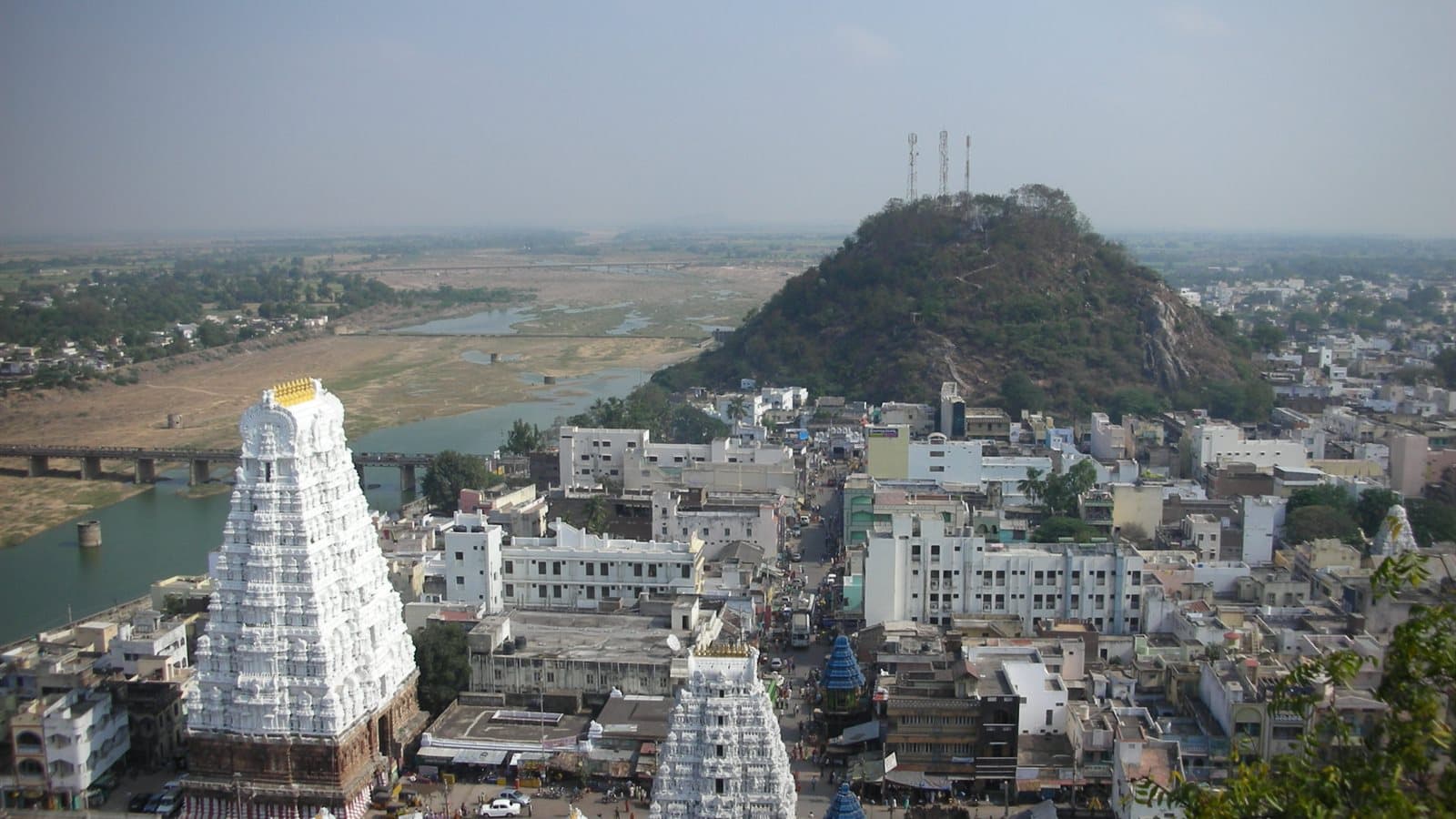
The temple is built in Dravidian style at the very foot of the hills, set so close against the rock that the inner shrines have the feeling of a cave temple carved into the mountain. The great Rajagopuram, raised by Krishnadevaraya, rises over the entrance, while a separate gateway and the hundred-pillar mandapam stand along the approach (a section of the main gopuram collapsed in 2010 and was rebuilt). Within, the sanctum enshrines the white Vayu Linga of Kalahasteeswara, before which two lamps burn with a flame that flickers without cease though no breath of wind reaches the windless chamber; the priests perform abhishekam without ever touching the linga directly. The shrine of the Goddess Gnana Prasunamba stands within the complex, and a steep flight of steps descends to the underground Patala Ganapati. The temple lies between the Durgambika hill and the Kannappa hill, with the Swarnamukhi river flowing below, the setting that earns it the name Dakshina Kailasam, the Kailash of the South.
Garbhagriha (Vayu Linga)
sanctumThe cave-like inner sanctum enshrining the white Vayu Linga of Kalahasteeswara. Before it two lamps burn with a flame that never stops flickering though the chamber is windless, the sign of the air element. The linga is worshipped without ever being touched by human hands.
Vayu (Air) element · linga untouched
Rajagopuram
gopuramThe towering main gateway raised by the Vijayanagara emperor Krishnadevaraya in the early sixteenth century. A section of the great gopuram collapsed in 2010 and was subsequently rebuilt; it remains the soaring landmark of the temple town.
Built by Krishnadevaraya, c. 1516
Hundred-Pillar Mandapam
mandapamThe pillared hall of the Vijayanagara period, its columns carved with deities and yali figures, standing along the approach to the temple and used for festival gatherings.
Gnana Prasunamba Shrine
otherThe shrine of the Goddess Gnana Prasunamba (also called Gnanaprasunambika), consort of Kalahasteeswara, worshipped within the complex for wisdom and grace.
Patala Ganapati
otherAn underground shrine of Ganesha reached by a steep, narrow descent of steps below the temple. Devotees go down to worship Ganapati in the cool, lamp-lit cavern before proceeding to the main darshan.
Underground Ganesha shrine
Setting Between the Hills
otherThe temple is built at the foot of the rock between the Durgambika hill and the Kannappa hill, with the Swarnamukhi river flowing below, a dramatic setting that earns it the name Dakshina Kailasam, the Kailash of the South.
Swarnamukhi River
tankThe sacred river flowing past the temple, in which pilgrims bathe before worship. Its name means 'golden-faced', and it is integral to the temple's rituals and to the legend of the elephant Hasti who bathed the linga with its water.
Sub-shrines & Other Deities
Gnana Prasunamba
The Goddess, consort of KalahasteeswaraThe principal Goddess of the temple, worshipped for knowledge, wisdom and grace, with her own shrine and festivals within the complex.
Patala Ganapati
Lord GaneshaGanesha enshrined in an underground cavern reached by a steep flight of steps, worshipped by descending pilgrims for the removal of obstacles before the main darshan.
Kannappa Nayanar
The hunter-saint KannappaThe devotee who offered his eyes to the Lord is honoured at the temple and on the Kannappa hill above, his story recited as the height of selfless bhakti.
Dakshinamurthy & the Nayanmars
Shiva as the teacher, with the Shaiva saintsShiva worshipped as Dakshinamurthy and the Nayanmar saints venerated in the precinct, marking the temple's place in the Tamil Shaiva devotional tradition.
Highlights
- 1One of the Pancha Bhoota Sthalams, the five temples of the great elements, representing Vayu (Air or Wind); the Vayu Linga is worshipped here
- 2The lamp flames in the windless inner sanctum flicker constantly, taken as the living sign of the air element; the main linga is never touched by human hands
- 3The foremost temple in India for the Rahu-Ketu Sarpa Dosha Nivarana pooja, drawing devotees from across the country and the world
- 4The sacred ground of Kannappa Nayanar, the hunter-saint who offered his own eyes to the bleeding linga, one of the most beloved stories of bhakti
- 5Named for three devotees, Sri (the spider), Kala (the serpent) and Hasti (the elephant), who worshipped Shiva here and attained liberation
- 6A Paadal Petra Sthalam sung in the Tamil Thevaram, set on the Swarnamukhi river between the Durgambika and Kannappa hills
- 7The towering Rajagopuram of Krishnadevaraya and the underground Patala Ganapati shrine reached by a steep descent
Festivals & Events
Maha Shivaratri Brahmotsavam→
February–March (Magha)The temple's greatest festival, a twelve-day Brahmotsavam around Maha Shivaratri, with night-long worship, abhishekam, processions of the deities on various vahanas and the great Rathotsavam (car festival).
Karthika Deepam→
November–December (Karthika)The festival of lights sacred to Shiva, observed with deepa aradhana and special worship through the holy month of Karthika.
Sri Gnana Prasunamba Festivals
VariesSpecial celebrations and Navaratri worship honouring the Goddess Gnana Prasunamba, consort of Kalahasteeswara.
Annual Theppotsavam
VariesThe float festival, when the processional deities are taken on a decorated float, celebrated on the temple tank or river during the festival season.
Sevas & Poojas
Rahu-Ketu Sarpa Dosha Nivarana Pooja
dailyThe temple's most famous ritual, performed before Kalahasteeswara to remedy the afflictions of Rahu and Ketu, Kala Sarpa and Sarpa Dosha in the horoscope, sought for delays in marriage, childlessness, illness and obstacles. Conducted in batches through the day, with the Rahu Kalam hours considered most potent.
Abhishekam to Kalahasteeswara
dailySponsored ritual bathing and worship of the Vayu Linga, performed by the priests without the linga being touched by hand, as is the custom of this shrine.
Archana & Sahasranama
dailyOffering of worship and recitation of the Lord's names in the devotee's name and birth-star, performed by the temple priests.
Kalyanotsavam / Special Pooja
specialSponsored special worship and the symbolic celestial wedding of the Lord and Goddess, performed on the devotee's behalf.
Fees and timings are indicative and may change. Please confirm with the temple office before travelling.