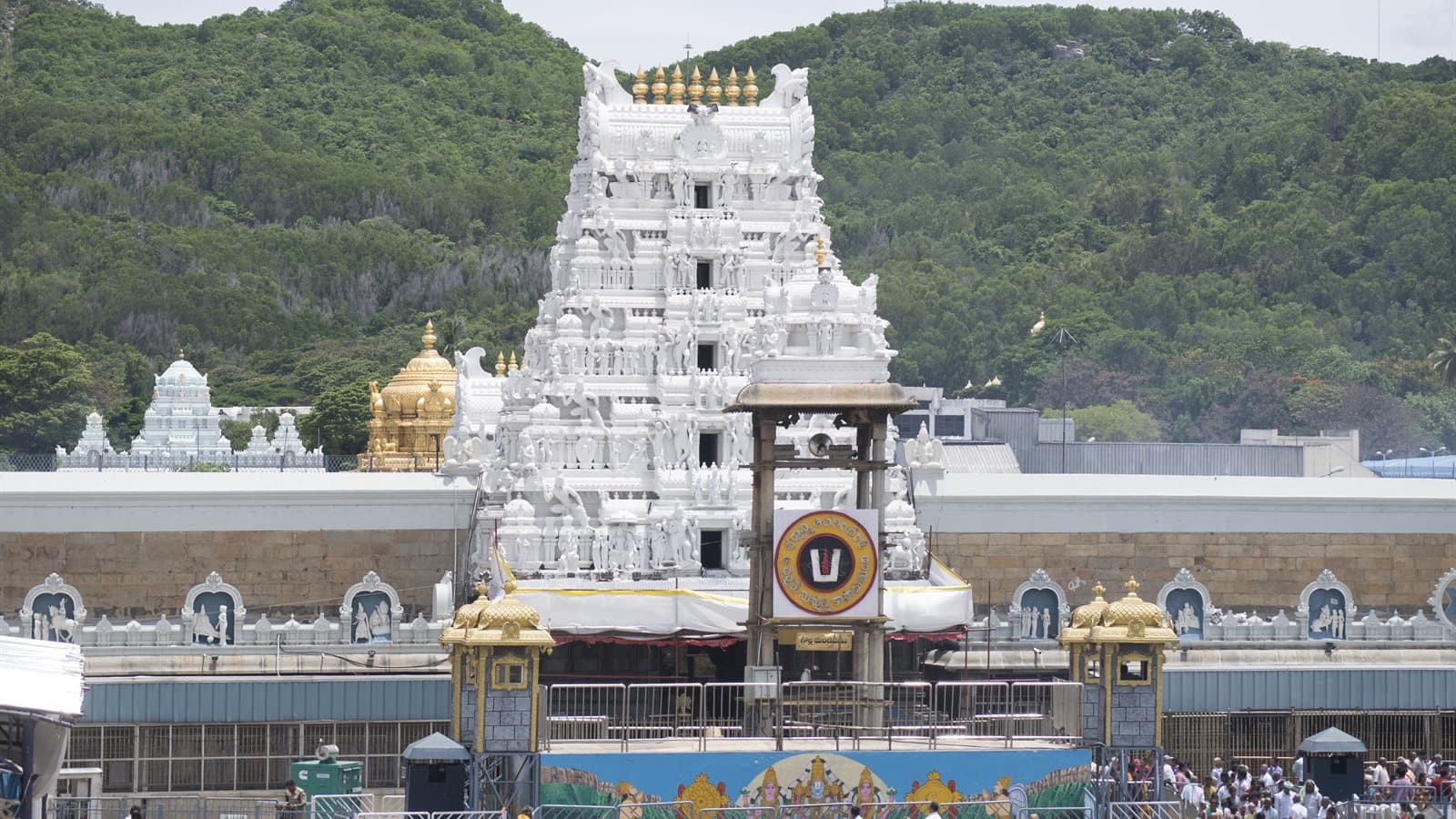
Tirupati Venkateswara
The richest and most visited temple in the world, dedicated to Lord Venkateswara (Balaji). Situated atop the Tirumala hills, it attracts over 50,000 pilgrims daily.
Official WebsiteHistory
The Tirupati Venkateswara Temple, also known as the Tirumala Temple, is a Vaishnavite temple dedicated to Lord Venkateswara (a form of Vishnu). The temple is believed to have been visited by Ramanuja, the 12th-century philosopher who is said to have performed the Anointment of Lord Venkateswara. References to this temple appear in early Tamil literature, including the Divya Prabandha by the Alvars. The Tirumala Tirupati Devasthanams (TTD) trust, established in 1933, now administers the temple and manages the world's largest religious endowment.
Mythology & Legend
The Legend
Once, sage Bhrigu was sent by a council of rishis to determine the supreme among the Trimurti. Finding Vishnu reclining on Adi Shesha in Vaikuntha, apparently asleep and inattentive, the enraged Bhrigu kicked him in the chest. Vishnu calmly took the sage's foot and gently massaged it, but Goddess Lakshmi, who resides on Vishnu's chest, was deeply insulted by both the kick and the fact that Vishnu had pardoned the offence. She left Vaikuntha for Earth in search of a quieter dwelling, settling at Kolhapur as Mahalakshmi. Vishnu, separated from her, descended to the Venkata hills as Srinivasa, 'the abode of Sri', to find her.
The Divine Wedding
On Earth, Srinivasa lived a life of austerity at Tirumala until he encountered the beautiful Princess Padmavathi, daughter of King Akasa Raja, at Narayanavanam. She was an incarnation of Lakshmi herself, born of a lotus from the earth. Srinivasa won her in marriage, but the wedding required vast wealth he did not possess. He borrowed an enormous sum from Kubera, the god of wealth, agreeing to repay only the interest until the end of Kali Yuga; the principal is to be repaid at the dawn of the next yuga. This is why devotees still pour their wealth (money, gold, hair and jewellery) into the temple Hundi: each donation is a token contribution toward Lord Venkateswara's debt to Kubera.
Why Devotees Offer Their Hair
An old legend traces the hair-offering custom to a kind cowherd boy whose ox was struck by a stone meant to chase it away. The stone hit Lord Venkateswara on the head, dislodging a patch of his hair. A passing princess, Neeladevi, saw the bleeding scalp and cut off her own beautiful tresses to cover the wound. Touched by her sacrifice, the Lord declared that henceforth he would receive the hair of every devotee who offered it at his temple, and that Neeladevi would receive the blessings on his behalf. The tonsuring of one's head at Tirumala is therefore both an act of surrendering one's pride (the hair as a symbol of vanity) and a settlement of one's share of the debt to Kubera.
The Seven Sacred Hills (Sapta Giri)
Tirumala stands on seven sacred hills, collectively the Seshachalam range, the seven hoods of Adi Shesha, the cosmic serpent on whom Vishnu reclines. Their names are: Seshadri, Neeladri, Garudadri, Anjanadri, Vrishabhadri, Narayanadri and Venkatadri. The Lord's name 'Venkateswara' means the destroyer (eswara) of sins (venkata, from 'vem' = sins and 'kata' = destroyer). The path of Alipiri Mettu, with its 3,550 stone steps, threads through these hills and is the ancient pilgrim route to the temple.
Architecture
The temple is built in Dravidian architecture style with a distinctive golden Vimana (tower). The Ananda Nilayam (sanctum) is covered in gold plates. The Bangaru Vakili (golden door) leads to the main sanctum. The temple complex includes Hundi (donation box), Ranganayakula Mandapam, and the sacred Pushkarini tank.
Ananda Nilayam Vimana
vimanaఆనంద నిలయం
The three-tiered gilded tower directly above the sanctum, the most sacred element of the temple. The name means 'Abode of Bliss'. Its ~32 m gold-plated surface dominates the Tirumala skyline; the topmost finial holds the famous Vimana Venkateswara, a smaller replica image believed to bestow the same darshan benefit when viewed from outside.
Three tiers · ~32 m gold-plated
Garbhagriha (Sanctum)
sanctumThe inner sanctum housing the ~8-foot tall self-manifest (svayambhu) murti of Lord Venkateswara, standing on a Padmapeetham. The deity holds the Shankha and Chakra in his upper hands; his lower hands rest in Varada and Hasta mudras. The image is famously said to maintain a body-warm temperature even in the cold sanctum.
Bangaru Vakili (Golden Door)
otherThe 'Golden Doorway' that separates the Antarala mandapam from the Garbhagriha. Its silver-and-gold-plated doors are carved with the ten avatars of Vishnu. The threshold is so revered that pilgrims touch it with their foreheads as they pass through to the sanctum.
Mahadwaram (Main Entrance)
gopuramThe principal entrance gopuram on the east, also called the Padikavali. Built in the Chola–Vijayanagara style with five tiers and topped by a single kalasham. Pilgrims pass beneath it to enter the temple complex from the Mada streets.
Tirumamani Mandapam
mandapamThe 'Hall of the Sacred Bell', between the Mahadwaram and the inner enclosure. Daily Sahasranama Archana, Sahasra Deepalankarana and many of the major Arjita sevas are performed here. Its bells ring at every transition of the daily ritual cycle.
Vimana Pradakshinam
otherThe innermost circumambulatory path around the Ananda Nilayam Vimana. Walking three times around the Vimana is considered equivalent to viewing the deity itself, particularly meaningful on busy darshan days when sanctum-time is brief.
Sampangi Pradakshinam
otherThe outer circumambulatory corridor, lined with smaller shrines, mandapams, and the Tirumamani Mandapam. It is the path most pilgrims take on their way to the inner enclosure.
Snapana Mandapam
mandapamThe 'anointing hall' where the daily Snapana Tirumanjanam (abhishekam to the processional Bhoga Srinivasa) is conducted every Friday, the only weekly abhishekam to a form of the main deity that pilgrims may witness.
Kalyana Mandapam
mandapamThe wedding hall where the daily Kalyanotsavam (symbolic re-enactment of Srinivasa's wedding to Padmavathi) is performed. Sponsors of the seva sit in the mandapam during the ritual and receive a special wedding cloth.
Swami Pushkarini
tankస్వామి పుష్కరిణి
The sacred lake immediately to the north of the temple. Bathing in it before darshan is part of the prescribed pilgrim ritual. The Garuda Stambham and the small Sri Varahaswamy shrine on its western bank mark the spot where pilgrims are expected to seek Varaha's permission before approaching Venkateswara.
Sapta Giri (Seven Sacred Hills)
otherThe temple sits atop the seventh of seven sacred hills, Venkatadri, collectively forming the Seshachalam range, said to be the hoods of Adi Shesha himself. The hills are: Seshadri, Neeladri, Garudadri, Anjanadri, Vrishabhadri, Narayanadri, Venkatadri.
853 m elevation · ~22 km from Tirupati town
Sub-shrines & Other Deities
Sri Varahaswamy
Lord Vishnu as Varaha (Boar Incarnation)On the bank of the Swami Pushkarini, this is the first shrine every pilgrim must visit. Varaha was the original lord of the Venkata hills and is said to have granted the land to Venkateswara on the condition that he be worshipped first. Skipping this darshan is believed to render the Venkateswara visit incomplete.
Sri Yoga Narasimhaswamy
Lord Vishnu as Narasimha in Yogic PostureA peaceful seated form of Narasimha (rather than the more common fierce posture) housed in a sub-shrine within the main complex. Devotees worship here for protection from fear and for inner stability.
Sri Andal (Goda Devi)
The Alvar SaintThe 9th-century Tamil poetess-saint, considered an incarnation of Bhumi Devi and the only female among the 12 Alvars. Her Tiruppavai hymns are recited daily in the Tirumamani Mandapam during the month of Margazhi.
Sri Ramanujacharya
The Vaishnava AcharyaThe 11th-12th century philosopher who codified Vishishtadvaita Vedanta and visited Tirumala seven times. His sub-shrine commemorates his role in establishing the temple's Vaishnavite practices and identifying Venkateswara conclusively as Vishnu.
Sri Vishvaksena
Commander of Vishnu's ArmyEquivalent to Ganesha in Vaishnava tradition, the remover of obstacles and the leader of Vishnu's celestial army. His shrine is invoked at the start of every major temple ritual.
Sri Garuda
Divine Mount of VishnuHoused in the Garuda Mandapam directly facing the Bangaru Vakili, where Garuda gazes eternally at his lord. Pilgrims briefly halt here before approaching the sanctum.
Hundi
Sacred Donation VesselNot a deity but central to the temple's ritual life: the great hundi (donation receptacle) in front of the Bangaru Vakili is where pilgrims offer money, gold, and jewellery, each gift considered a contribution toward Lord Venkateswara's eternal debt to Kubera.
Highlights
- 1World's most visited religious site with 50,000–100,000 pilgrims daily
- 2Sri Venkateswara's idol adorned with diamond crown and gold jewellery
- 3Tirumala hills (Seshachalam range) at 853 meters elevation
- 4Annual hair offering (Vastralankara), over 15 tons of hair donated daily
- 5TTD runs free annadanam for all pilgrims, one of the world's largest free kitchens
Festivals & Events
Brahmotsavam→
September–OctoberNine-day annual festival drawing millions of pilgrims. The deity is taken out in a grand procession on 9 different vahanas (vehicles).
Vaikunta Ekadasi→
December–JanuaryThe most sacred day when the Vaikunta Dwaram (Heaven's Gate) is opened. Darshan is given through this special door.
Rathasapthami→
FebruaryCelebrates the birthday of the Sun God. The deity is placed on a chariot and taken in a procession through the four streets of Tirumala from 4 AM to midnight on seven different vahanas.
Pushpa Yagam→
MayAnnual flower festival. The temple and processional deities are decorated with tonnes of flowers; a six-hour pushpa abhishekam is performed in the Tirumamani Mandapam.
Sevas & Poojas
Suprabhata Seva
dailyThe first ritual of the day: the deity is gently awakened with the recitation of the Sri Venkateswara Suprabhatam by Ramanuja's disciple Prativadi Bhayankaram Annan. The most sought-after Arjita seva at Tirumala; bookings open 90 days in advance via the TTD online portal.
Thomala Seva
dailyAdornment of the deity with fresh tulsi garlands and silken vastrams (clothes) after Suprabhatam. Pilgrims observe the alankaram from the Sampangi Pradakshinam.
Archana / Visesha Pooja
dailyRecitation of the 108 sacred names of Lord Venkateswara (Ashtottara) and the 1,008 names (Sahasranama), each with offering of flowers, in the Tirumamani Mandapam. Sponsors receive sankalpam in their name.
Kalyanotsavam
dailyThe symbolic re-enactment of the wedding of Srinivasa, Padmavathi and Bhu Devi. Performed daily in the Kalyana Mandapam. Sponsors witness the full Vedic ceremony and receive a special wedding cloth, laddus, and a framed photograph of the deities.
Sahasra Kalashabhishekam
weeklyAnointing of the Snapana Beram with water from 1,008 sacred kalashams. Among the most spiritually charged of the Arjita sevas. Booking essential.
Astadalapadapadmaradhana
weeklyEight-petalled lotus archana to the deity's feet with 108 golden lotus petals. A Monday-only seva first introduced in 1989.
Tiruppavada Seva
weeklyMountain of cooked rice (~6 quintals) is offered to Lord Venkateswara as naivedyam, then distributed as prasadam. A Thursday tradition.
Vasantotsavam
weekly'Spring festival' performed in the Vasantha Mandapam for the processional deities, Sri Devi, Bhu Devi and Malayappa Swami. Conducted twice weekly.
Sahasra Deepalankarana Seva
daily'A thousand lamps illumination' of the processional Malayappa Swami in the Unjala Mandapam each evening. A serene, lamp-lit darshan.
Ekantha Seva
dailyThe final seva of the day: the deity is put to bed (palli kondu) in the inner sanctum with a recitation of the Tarigonda Vengamamba's lullabies. The temple closes after this for the night.
Fees and timings are indicative and may change. Please confirm with the temple office before travelling.